Dubai Metro station access from home: time the real walk
Buying near a Dubai Metro station? Check the gate, crossing and first train, then use RTA fares to price your own commute from Al Furjan or elsewhere.
For a home near a Dubai Metro station, time the walk from your own front door to the platform. As of November 2026, Nakheel quotes six minutes from Murooj Al Furjan to Al Furjan station, but leaves the starting gate and the mode of travel unspecified.
How close is the Dubai Metro station to your front door?
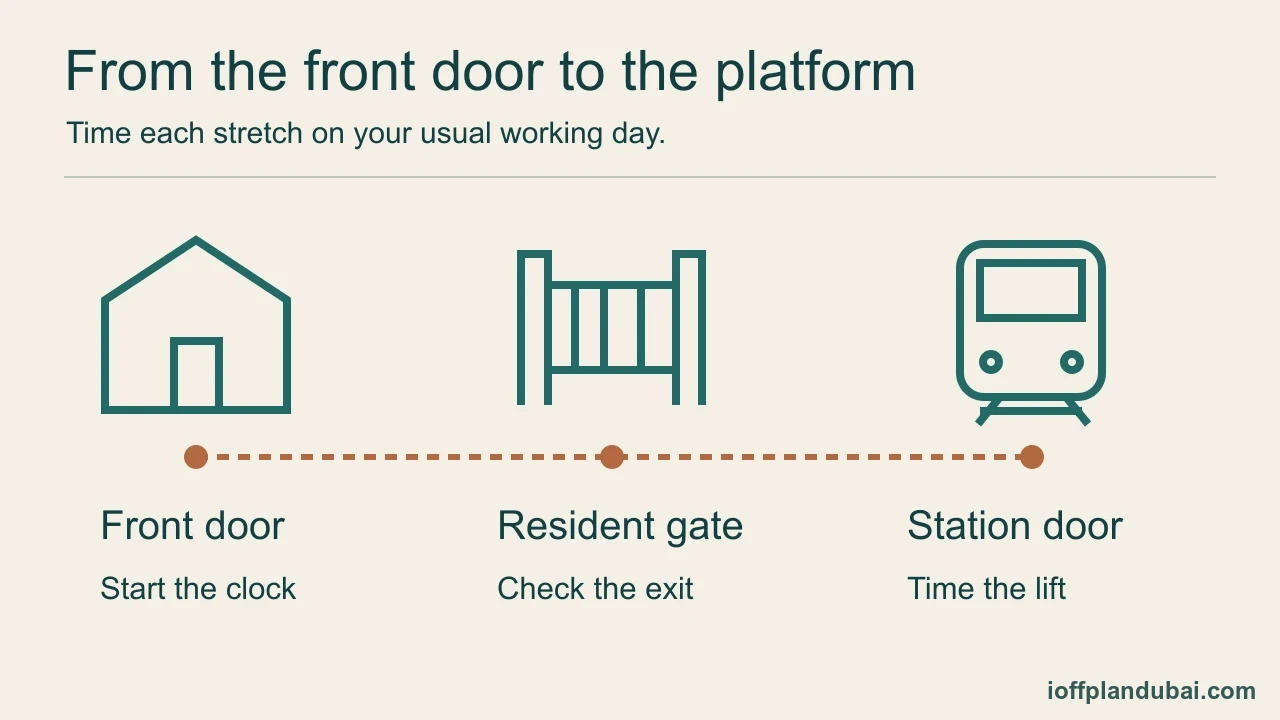
Ask for two pins before the viewing. One should mark the pedestrian gate your household can use. The other should mark the station entrance on that side of the road. A pin in the middle of the tracks is little help when you’re standing across a junction looking for a crossing.
| Start your clock here | Record this | Why keep it separate? |
|---|---|---|
| At the flat or villa door | Minutes to the resident gate, including the lift | Two homes in the same development can have different exits |
| At the gate | Walk to the station door, including waits to cross | This is the stretch you’ll cover in the heat |
| At the station entrance | Minutes to your platform by your usual route | A lift or a bridge can add time after you’re indoors |
| At the other end | Exit to your desk, school or appointment | The closest arrival station may have an inconvenient exit |
On your phone, save the times beside the gate and entrance names. A partner who missed the viewing should be able to repeat the journey from your note. If one stretch is behind construction fencing, leave its time blank and mark the route you could actually take that day.
What does Nakheel say about Al Furjan?
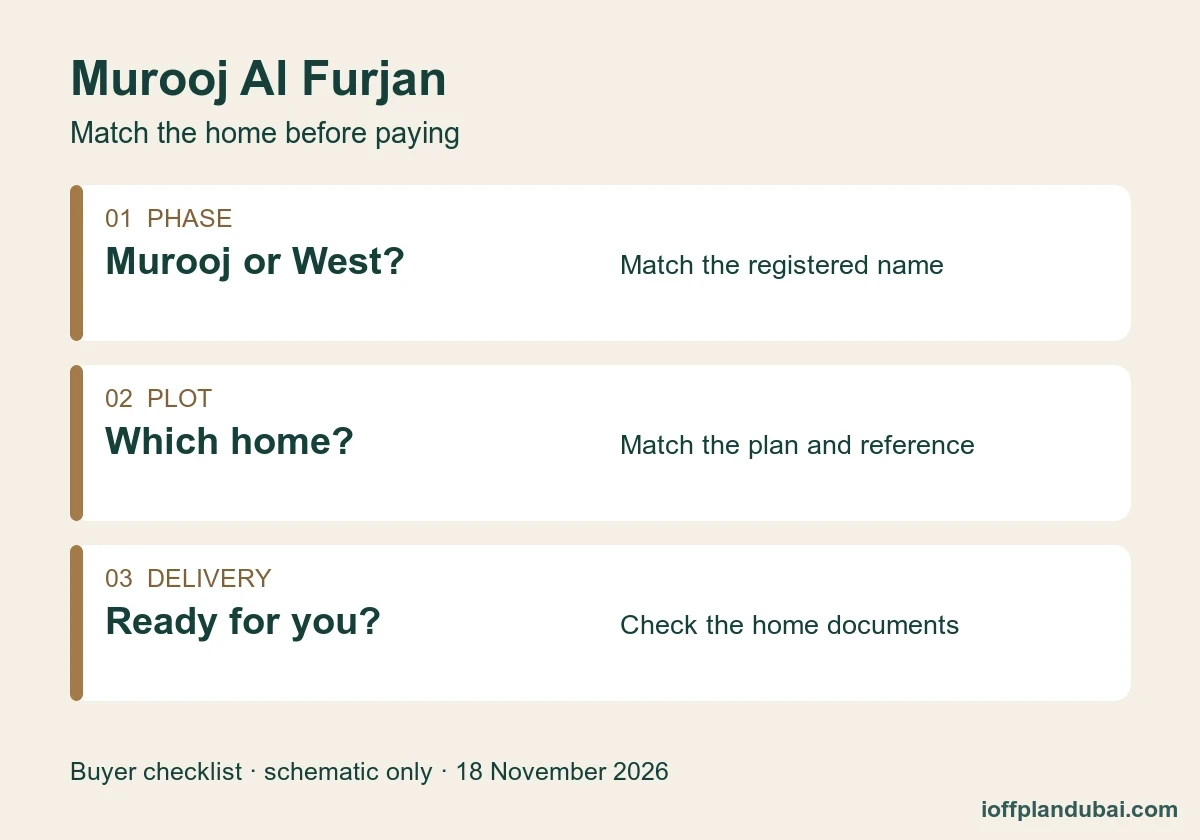
Nakheel’s Murooj Al Furjan page names the station among local amenities and gives that six-minute figure in its location section. It also distinguishes the East and West parts of Murooj. Ask which part the offer covers before arranging to meet anyone at a gate. The Murooj Al Furjan villa guide explains which plan to request for the home.
For a villa at Tilal Al Furjan, start again with its own plot. A Murooj travel estimate tells you little about leaving a Tilal driveway on foot. Ask the seller one question. “Which pedestrian exit would I use on Monday morning, and can a resident use it today?” If the answer gives a driving route, keep it for the school run and ask for the walk separately.
Have someone meet you at the station for the return leg. Give them the entrance name alone and see where they arrive. If you end up on opposite sides of the road, you’ve found a detail worth recording before a child, guest or visiting parent makes the trip alone.
Will the first or last train work for your shift?
Look up your departure station in RTA’s train timetable. Choose the direction and day you’ll travel. A system opening hour can’t tell you when the first train reaches your platform. For a late return, start with the last service you need to catch and work backwards to the time you must leave work.
For example, suppose your shift ends at 11 pm. Allow time to change clothes, leave the building and reach the platform at the work end. If the journey needs a change, check whether you can board the connecting train as well. Save the service for the day your shift ends, particularly if you leave work after midnight. Recheck with RTA for holidays and changes.
RTA’s S’hail journey planner lets you compare a walk and train with a bus and train. Enter your destination door and actual departure time. Check the return journey independently. If the evening bus leaves before you reach the stop, a short distance on the map may mean paying for the last leg home.
Can everyone in the household make the walk?
Try it with the person who’ll use it. A younger adult walking across an empty junction on a cool morning can’t tell a parent much about doing the same journey with a pushchair and bags. Pay particular attention to the last kerb before the crossing and the first one on the far side. Can you stay on the pavement throughout?
RTA’s Metro passenger guide describes lift access to station levels and tactile guidance inside stations. Outside, follow the pavement from your gate all the way to the accessible entrance. If a map takes you to steps, find the lift and time the detour. Ask station staff where you’d enter if that lift were out of service. Save their directions with the entrance name.
Use the same test at the far end if someone needs a step-free trip to work. Look for the kerb cut nearest the office entrance as well. The guide to walking routes near Dubai parks gives a similar gate-to-gate check for families combining the train journey with a nursery pickup or a stop at the playground.
How much would the commute cost each month?
The RTA nol fare table lists Silver card fares of AED 3 within one zone, AED 5 across two adjacent zones and AED 7.50 for more than two zones, checked 19 November 2026. Find the zones for your actual journey before choosing a figure. A close station can still be several fare zones from your workplace.
Suppose one adult travels out and back on 20 workdays across two adjacent zones. That’s 40 journeys at AED 5, or AED 200 for the rail journeys in this example. RTA lists AED 230 for a 30-day, two-zone Silver pass. At those assumptions, paying per journey costs AED 30 less. RTA specifies a registered Silver or Gold card for the 30-day product.
Add weekend trips if you’d make them anyway. At AED 5 each way, three extra return trips use up that AED 30 difference. Keep taxi receipts, parking and any separate trips in a second column. Otherwise a cheap train fare can hide an expensive connection between the villa and the station every evening.
How do you compare two homes on the same line?
Compare one full working week. Suppose the walk from home A takes eight minutes each way and the walk from home B takes fifteen. Over five return commutes that’s a difference of 70 minutes. Those are illustrative walking times. Substitute your own measurements, including the lift wait if you started the clock at the front door.
Now ask where the extra minutes fall. Seven minutes under cover on the way to a train can feel quite different from seven minutes waiting at an exposed crossing with shopping. Write down which part would persuade you to take a taxi. That detail may matter more to your family budget than the weekly time difference.
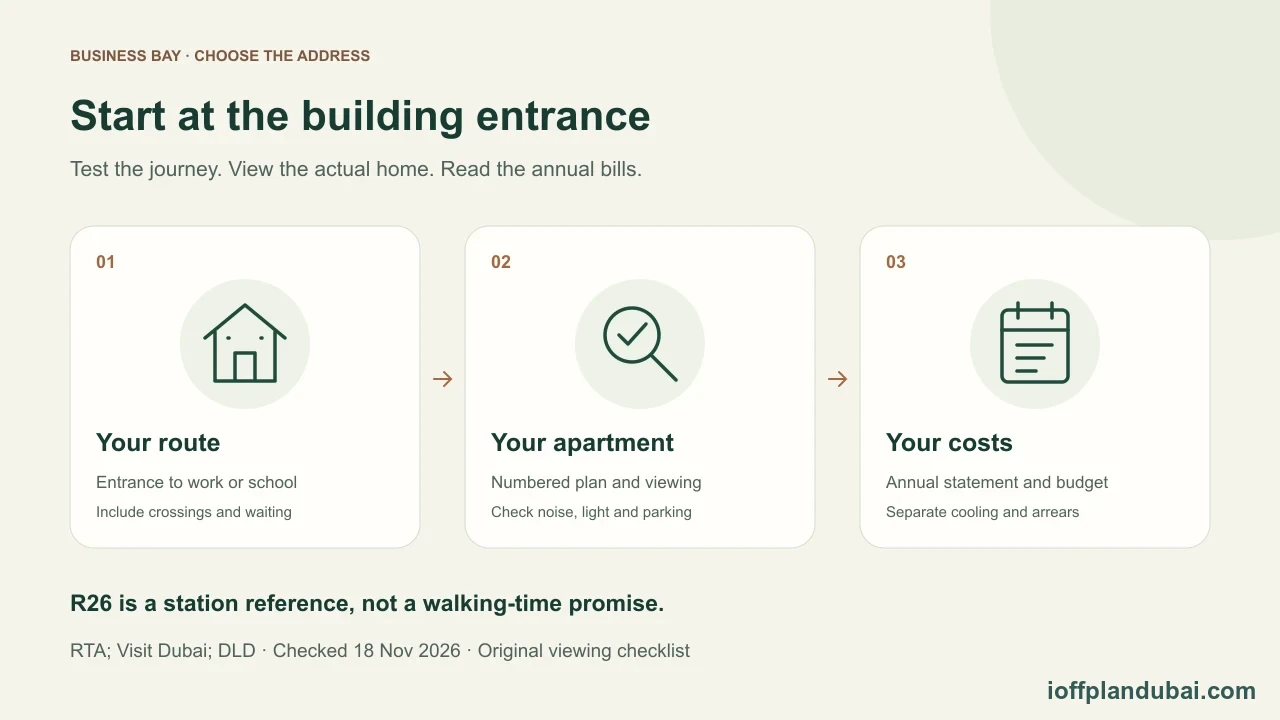
Repeat the calculation for the second traveller if there is one. A flat well placed for someone commuting towards Downtown may leave their partner with a difficult connection. The Business Bay area guide can help you plan the viewing at the destination end. For a home at Avenue Park Towers, take the proposed tower entrance to the viewing so you can check exactly where your own journey would begin.
What if the closest gate or station is still planned?
Ask the developer to mark the open route and the proposed route on a dated plan. A future gate might make a home much easier to live in. Until you can walk through it, work out your first-month commute using the gate available now. If the railway itself is proposed, price the journey using the service that runs today.
Keep the housing and transport dates side by side. Ask the developer when residents are expected to receive keys to the home and access cards for the gate. Look to RTA for train service announcements. A date on the home’s payment schedule tells you when an instalment is due. It gives you no departure time for a train.
Before you pay a reservation amount, take the paperwork back to the route that made you choose the property. If an open pedestrian link by move-in is essential, ask your adviser to show you where that commitment appears in the documents you’re about to sign. Without it, decide whether you’d still choose the home using the longer route.
FAQ
Does “near Metro” mean I can walk to the station?
You need the route from a resident entrance to a station door. Ask the person quoting a time to identify both and say how they travelled. If they can show only a drive, walk the available pavement yourself before relying on the estimate.
Should I visit in the morning or evening?
Choose the trip with the tightest deadline. For an early shift, try to reach the platform for the train you actually need. For a late shift, start at work and see how you’d get through the community gate on the way home.
What should I keep after the viewing?
Keep the marked plan, your outward and return times, the fare zones and the date you checked the timetable. Circle any part you couldn’t try. Someone reading your notes should be able to tell which minutes you measured and which ones still depend on a gate opening.
Sources
- Nakheel — Murooj Al Furjan — nakheel.com · checked
Developer quotes six minutes to Al Furjan Metro Station. Mode, start point and station entrance are unspecified.
- Dubai Roads and Transport Authority — Metro and Tram timings — rta.ae · checked
First and last train times by station, direction and day. Check the latest schedule and service notices before travelling.
- Dubai Roads and Transport Authority — nol fares — rta.ae · checked
Silver card fares per journey in AED by zone and pass prices in AED by duration and zones.
- Dubai Roads and Transport Authority — Dubai Metro passenger guide — rta.ae · checked
Station accessibility provisions, including lifts and tactile guidance. No information on streets outside a particular entrance.
- Dubai Roads and Transport Authority — S’hail journey planning — rta.ae · checked
RTA describes bus and rail journey planning and service alerts.
Next stepDue diligence →
More in Due diligence
Start here: Due diligence
- Kids play area in Dubai: what to check on a viewing
- Kids play areas in Dubai: which open with your home?
- Marina yacht club access in Dubai: who gets a berth?
- Multi-purpose room in Dubai: can you host a private lunch?
- Nursery near your Dubai home: how to confirm a place
- Office lounge in a Dubai home: who gets the room key?