House swapping and subleasing in Dubai: a 2026 guide
House swapping and subleasing in Dubai need different checks. Read the 2026 shared-housing changes, landlord consent rules and handover checklist.
For house swapping and subleasing in Dubai, check the permission to use the home before you exchange keys or pay. As of 16 November 2026, an ordinary tenancy, regulated shared housing and a holiday home follow different routes; written landlord consent alone doesn't settle every arrangement.
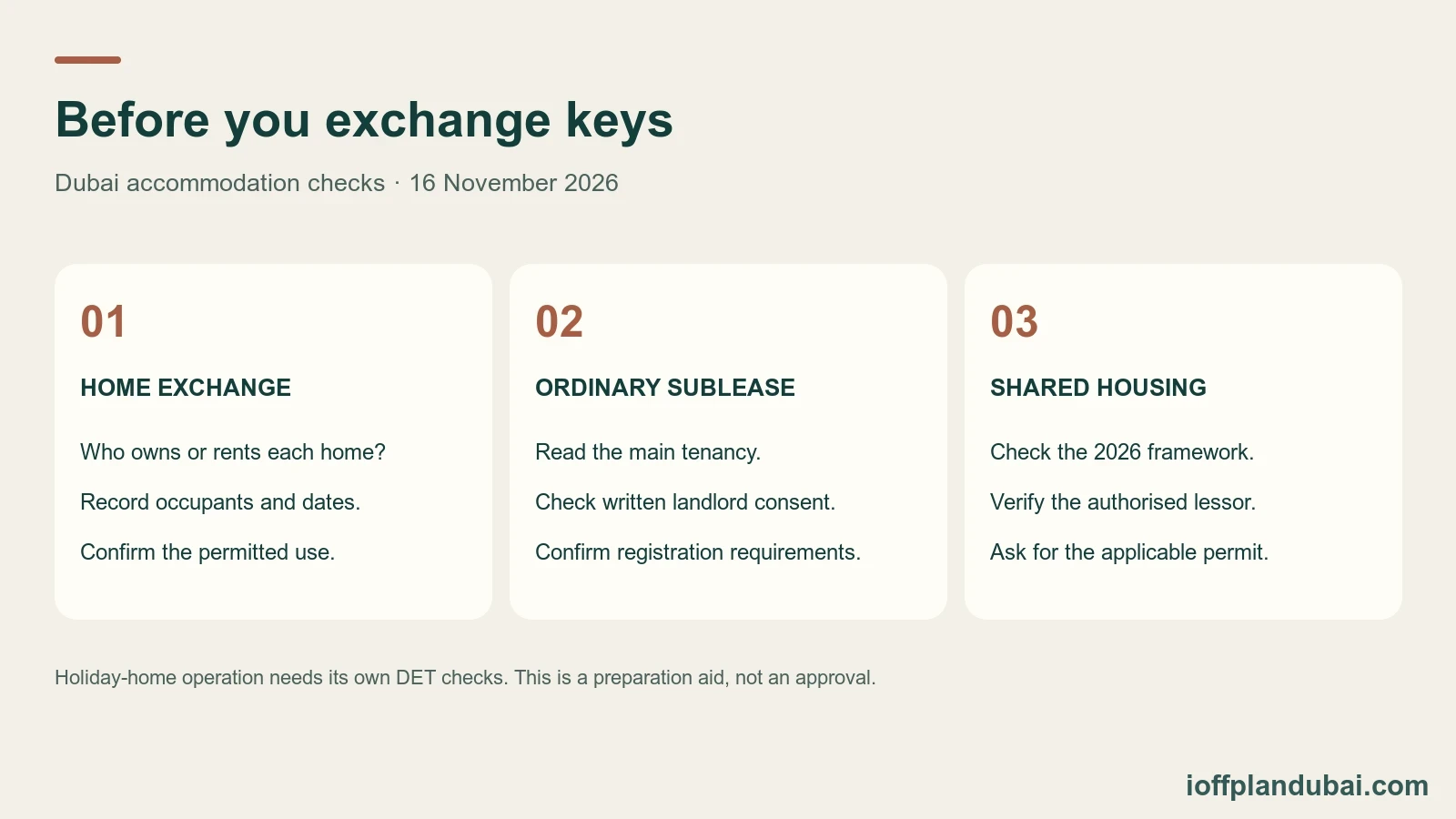
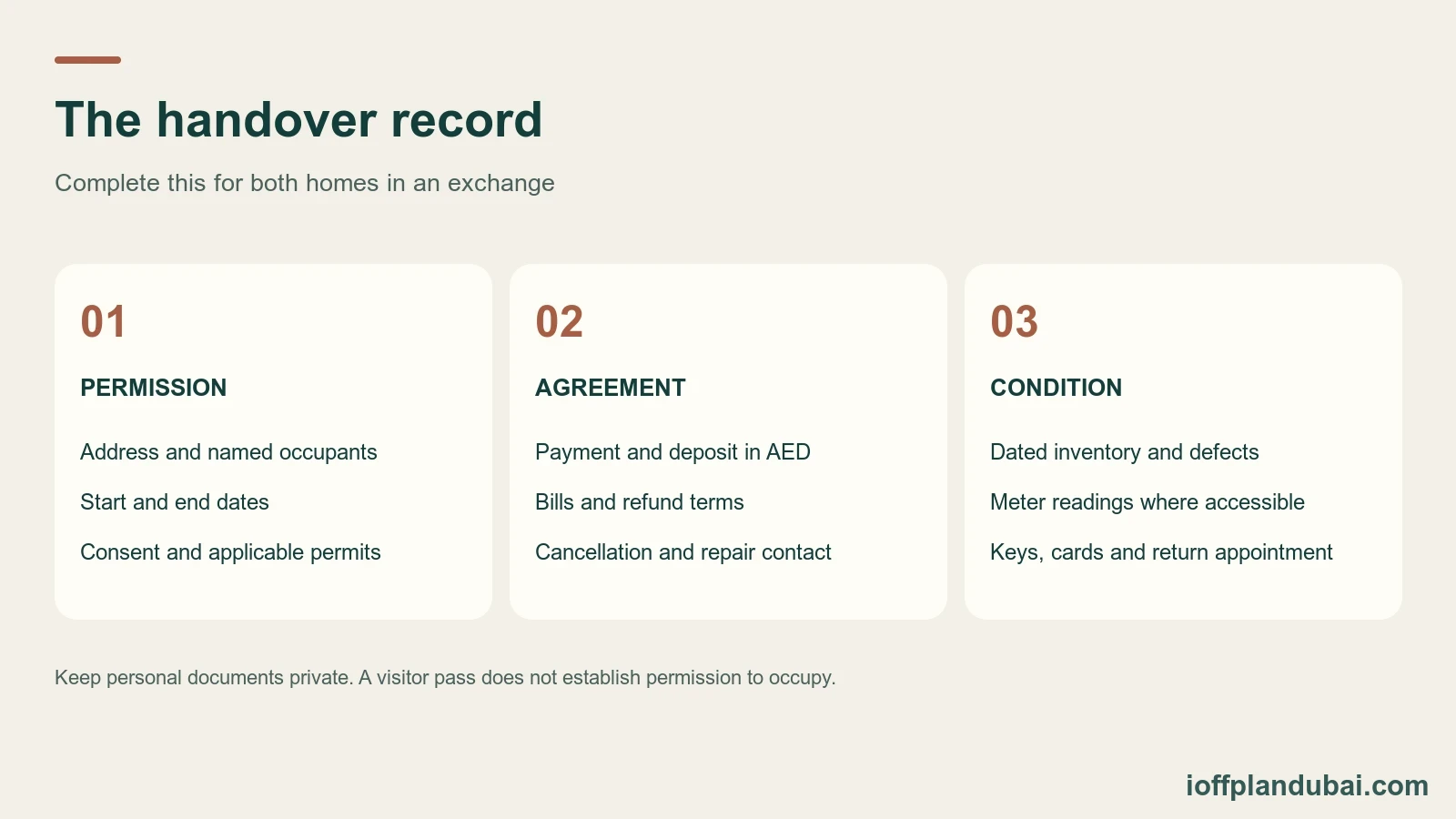
Write down who will stay, which rooms they'll use, the dates and what each person gives in return. A platform's label cannot answer those questions for your landlord or the authorities. If you're renting while waiting for an off-plan home, leave room for a delayed handover before promising your current apartment to someone else.
What do house swapping and subleasing mean here?
A house swap usually means two households exchange accommodation for an agreed period. A sublease means a tenant lets another person occupy all or part of the rented home under a separate agreement. A permanent exchange of owned properties is a different transaction involving ownership documents.
Use this table to identify the question you need answered. These are practical descriptions, not official classifications of your proposed stay.
| Your arrangement | First question to settle |
|---|---|
| Two owners exchange homes temporarily | Is this use permitted for each property, and does either stay fall within holiday-home rules? |
| Two tenants exchange rented apartments | Has each landlord approved the specific transfer of use? |
| A tenant lets the whole apartment during an absence | What does the lease permit, and which registration or permit route applies? |
| Someone offers a bedroom or bed space | Is this regulated shared housing, who is authorised to let it, and where is the permit? |
| Two owners permanently exchange their properties | How will both title transfers and any financing be completed? |
For the last situation, read the property ownership exchange guide. Swapping keys for a month doesn't transfer title, and a title-transfer service doesn't authorise a temporary letting.
What does the landlord need to approve?
For an ordinary tenancy, Article 24 of Dubai's tenancy law addresses assignment of use and subleasing. Unless the parties have agreed otherwise, written landlord consent is required. Read the actual lease, including its additional terms, before relying on a general statement that subletting is allowed.
Ask the landlord to identify the property, approved occupants, dates and permitted use in writing. If a representative signs, ask what authority they hold. A message from the current tenant saying “the owner knows” isn't the owner's approval.
For an exchange involving two rented homes, run the check on both sides. Permission for the Dubai apartment says nothing about the other home. If one approval is refused, have a cancellation arrangement that doesn't leave either household without somewhere to stay.
Keep building access separate. Security may arrange a visitor pass or move-in booking, but that doesn't answer the contractual question. Ask management about keys, parking and access cards after you've settled the occupancy permission.
Source: Dubai Supreme Legislation Committee, Law No. 26 of 2007, Article 24; checked 16 November 2026. Shared housing needs the separate checks below.
What changed for shared housing in 2026?
The Dubai Government's explanation of Law No. 4 of 2026 describes a permit system for shared housing. Only the owner or an authorised establishment may lease a shared-housing unit. Tenants and other parties may not sublease parts of it.
Dubai Municipality says the law took effect on 8 September 2026. Its October guide gives existing operations one year from that date to regularise. That period doesn't excuse unsafe building violations or unauthorised changes of use. Don't read it as permission to start a new informal room-rental business.
If you're offered a room, ask who is letting it and request the permit covering that accommodation. Match the address and the permitted use. Ask how your occupancy will appear in the applicable records. Get clarification from Dubai Municipality and DLD if the paperwork and the proposed arrangement differ.
You don't need to decide the legal category yourself. Send the authorities the facts: whole home or room, number of households, duration, payment and identity of the proposed lessor. Ask which route applies before paying a deposit.
Sources: Government of Dubai Media Office, 11 March 2026; Dubai Municipality, Shared Housing Guide announcement, 7 October 2026. Both checked 16 November 2026.
Does an unpaid swap avoid holiday-home rules?
Don't assume that it does. We couldn't confirm a universal official exemption for every unpaid or points-based exchange. Describe the arrangement to the relevant authority, including any membership fee, exchange credits or payment between participants.
For accommodation operated as a holiday home, the Department of Economy and Tourism's permit guidance says apartments and villas must be registered and approved before listing. A platform account and a landlord's email don't replace that approval.
Ask the person offering the home to explain the applicable permission and show the property-specific document. If they say no permit is needed, ask for the official basis for that answer. Keep the reply with your booking records. Don't advertise first and leave the classification question until guests arrive.
If the offer began in an app, use the UAE property-search app checklist to save the exact home, advertiser and dates. Check permission for the proposed stay separately from the ad.
Which documents should you check before paying?
Ask for these documents before you agree to pay. Keep identity documents private and share them only through the channel needed for the transaction.
| Document or record | What you check |
|---|---|
| Main tenancy or ownership evidence | The person offering the home has the relevant interest or authority |
| Consent or authority to let | Exact address, approved use, dates and signatory |
| Applicable permit and registration | The document covers this accommodation and the proposed arrangement |
| Occupancy agreement | Parties, rooms, dates, payment, cancellation and responsibility for damage |
| Condition record | Furniture, appliances, existing defects and keys actually supplied |
| Payment record | Amount in AED, recipient, purpose and agreed refund terms |
Read the Ejari and tenancy-contract guide alongside the main lease. Don't assume the original tenant's registration automatically records your own arrangement. Ask DLD how it should be documented under the applicable route.
Treat “pay today and we'll send the consent later” as an unresolved condition. Ask for the missing document before committing money. There is no verified universal deposit amount, swap fee or refund deadline for these private arrangements.
How should you divide bills and damage costs?
Write down who pays utilities, cooling, cleaning and any platform charges. For an exchange, agree this for each home separately. A reciprocal stay can still produce unequal bills or damage claims.
Hypothetical example: you agree to contribute AED 900 towards utilities for a 30-night stay. AED 900 ÷ 30 = AED 30 per night. That's your agreed allocation, not a Dubai tariff. Decide whether the amount is fixed or reconciled against actual bills, and what happens if the stay ends early.
Record any deposit separately from rent or bill contributions. State who holds it, which deductions need evidence and when the parties expect to settle it. Ask what happens if a final utility bill arrives after departure.
Check insurance directly with the insurer. Describe the exchange or subletting arrangement and ask about cover for the home, contents and liability. A platform's protection statement deserves the same reading: exclusions, claim evidence and who actually pays.
What should happen when you hand over the keys?
Walk through the home together, or agree a dated remote record. Photograph existing defects without including personal papers or belongings unnecessarily. Test the appliances you're expected to use, then record meter readings where accessible.
List the keys and cards by quantity. Confirm parking, access hours and whom to contact for an urgent repair. Agree what the occupant can authorise if something breaks, including any spending limit and the person who must approve larger work.
Before departure, arrange the inspection and return appointment. Record which items were returned and what remains to settle. Avoid giving a new occupant access beyond the agreed term just because their next accommodation isn't ready.
If you're ending your own tenancy, use the tenancy-cancellation guide for the separate close-out process. A replacement occupant or swap doesn't by itself settle your obligations to the landlord.
What if permission is missing or a dispute starts?
Pause the proposed stay and ask the owner or authorised operator to resolve the missing approval. Keep the agreement, payment records and relevant correspondence. Don't try to repair the paperwork by changing the label from “sublease” to “guest”.
The amended tenancy law allows a landlord to request eviction for unauthorised subletting. It addresses both tenant and subtenant; it doesn't mean a private person can bypass the dispute process or promise an automatic eviction date. Read the Rental Disputes Center guide before preparing a claim or responding to one.
Source: Dubai Supreme Legislation Committee, Law No. 33 of 2008, amended Article 25; checked 16 November 2026.
FAQ
Can I sublet while waiting for my new apartment?
Waiting for an off-plan handover doesn't create a separate right to sublet. Check your lease, the proposed use and the applicable permissions. If you need flexibility, ask for written extension and cancellation terms before promising fixed dates to another occupant.
Does security letting someone in prove the stay is approved?
No. A building access record answers an access question. Ask separately for the landlord's permission and any applicable permit or registration. Keep those records with the agreement rather than relying on a conversation at reception.
Is an owner-to-owner swap the same as selling the homes?
No. A temporary stay doesn't itself exchange ownership. Keep the occupancy dates and responsibilities in writing. For a permanent property exchange, check the documents and completion arrangements for both titles before treating either transfer as agreed.
Before you book, get a written answer to one question: who has authorised this person to give you this home for these dates?
Sources
- Dubai Supreme Legislation Committee — Law No. 26 of 2007 — dlp.dubai.gov.ae · checked
Article 24 addresses assignment of use and subleasing, subject to the agreement and written landlord consent. Read with amendments and the applicable 2026 shared-housing framework; not blanket permission for room rentals.
- Dubai Supreme Legislation Committee — Law No. 33 of 2008 — dlp.dubai.gov.ae · checked
Amended Article 25 addresses eviction requests for unauthorised subletting, including the tenant and subtenant. Article 4 addresses registration of leases and amendments. No automatic eviction timetable inferred.
- Government of Dubai Media Office — Shared housing law, 11 March 2026 — mediaoffice.ae · checked
Official explanation of Law No. 4 of 2026. Shared housing requires permits; only owners or authorised establishments may lease it, and tenants may not sublease parts. DLD manages the electronic shared housing record.
- Dubai Municipality — Shared Housing Guide, 7 October 2026 — dm.gov.ae · checked
Law effective 8 September 2026. Existing operations have one year to regularise, excluding unsafe building violations or unauthorised changes of use. Building permits and technical requirements apply. No determination for an individual home made.
- Dubai Department of Economy and Tourism — Hospitality services and permits — dubaidet.gov.ae · checked
Apartments and villas operating as holiday homes must be registered and approved before listing. Does not establish a universal classification or exemption for unpaid home exchanges.
Next stepRenew Ejari online with Dubai REST (2026 Checklist) →
More in Renting
Start here: Renew Ejari online with Dubai REST (2026 Checklist)
- How to Find Out Rental Value of Property (Dubai Guide)
- Amicable settlement Dubai: RDC filing (Step by Step)
- Rental Dispute Center Dubai: Documents and Case Fees
- Tasdeeq lease registration — Dubai or Ajman in 2026
- Dubai property resale: what existing tenants should do
- Best property management companies in Dubai: 2026 guide