Bora Bora at DAMAC Islands: buyer checks for 2026
Bora Bora at DAMAC Islands: identify the phase, compare home plans and check project records, payment terms and delivery documents before paying in 2026.
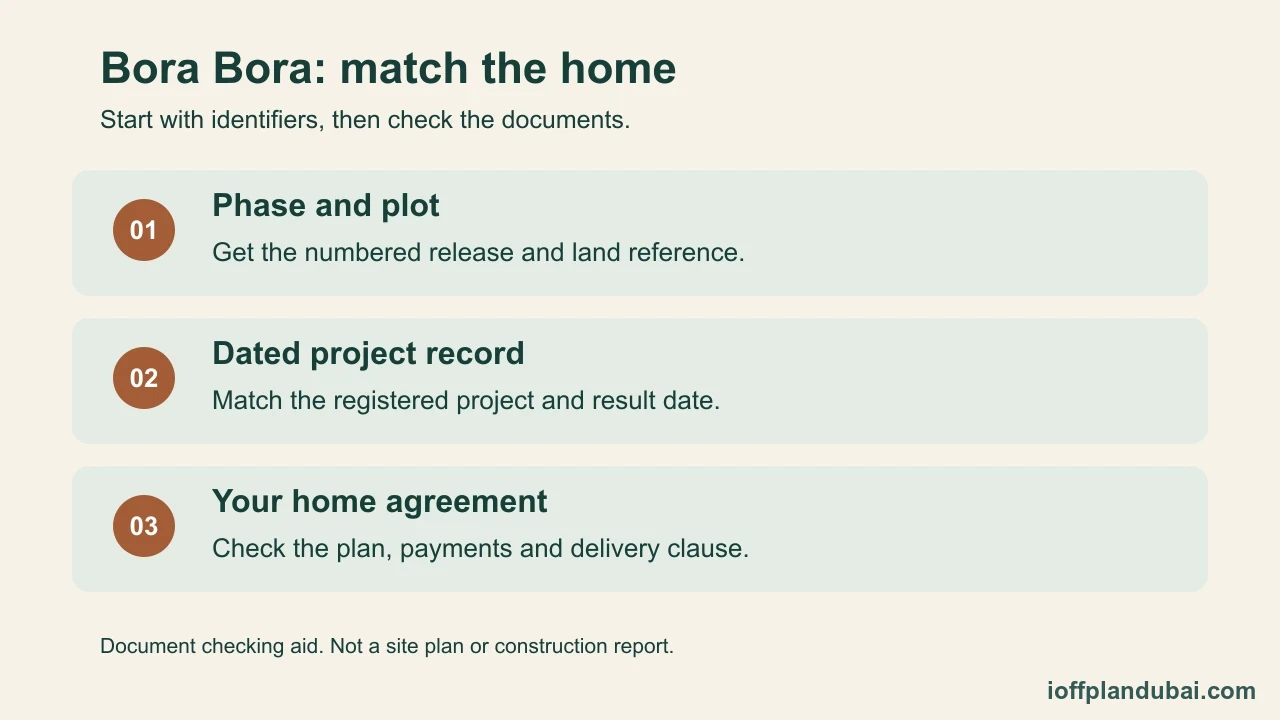
Bora Bora is a named cluster within DAMAC Islands, identified in DAMAC's launch announcement of 20 November 2024. As checked on 16 November 2026, start a purchase with the numbered phase and plot, then match the project record and agreement for your home. The cluster name alone doesn't establish its current price, construction progress or delivery date.
What is Bora Bora at DAMAC Islands?
DAMAC's original Islands announcement names Bora Bora among six island-themed clusters. The wider community announcement describes villas and townhouses. Treat that as the starting point for identifying a home, then ask for the plan and specification attached to its agreement.
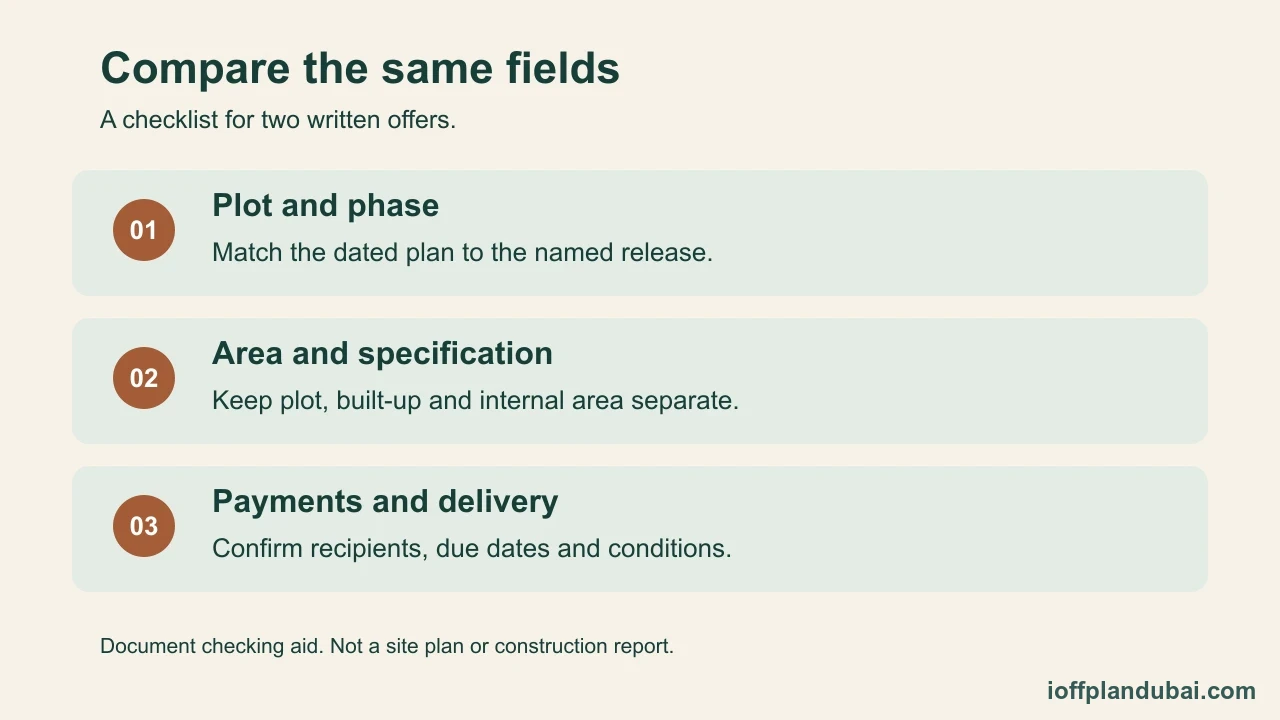
An advertisement can use the cluster name while the paperwork uses a numbered phase. Write down both. Ask the seller to identify the legal selling entity, registered project and land reference alongside the plot number.
The DAMAC Properties guide explains how to separate the developer brand from the company and project named in your documents. For the wider setting, use the DAMAC Islands community guide.
Source: DAMAC Properties, developer launch release dated 20 November 2024, distributed by PR Newswire; checked 16 November 2026. The release describes the community at launch, rather than today's inventory or a particular home's contract.
Which phase and parcel are you buying in?
DAMAC's historical digital brochure cluster map places Bora Bora 1 and 2 in Parcel 2, and Bora Bora 3 in Parcel 3. Check the numbered phase on each offer.
Ask for a dated plan showing your plot. Match its phase label to the offer, sale agreement and project reference. The old brochure helps identify names; it doesn't confirm current approved boundaries or the position of a newly offered home.
| Document | What should match | Question if it differs |
|---|---|---|
| Written offer | Numbered phase and plot | Which reference identifies the home being sold? |
| Plot plan | Plot boundary and orientation | Which dated version forms part of the agreement? |
| Project information | Registered name and land reference | Which official record covers this release? |
| Sale agreement | Selling entity and home identifiers | Will the seller correct the documents before signature? |
If you're comparing a nearby release, the Fiji 2 guide explains its separate phase identification. Use the same questions for both homes, rather than assuming that neighbouring clusters have identical payment or delivery terms.
Source: DAMAC Properties, undated historical DAMAC Islands digital brochure, cluster map; checked 16 November 2026. Parcel labels are historical brochure information, not a fresh boundary survey.
How do you check the location and daily journey?
Get the plot pin and the entrance expected to serve it. Trace the route from that entrance to work, school and the places you use each week. A journey estimate measured from a community boundary won't tell you the time from your front door.
Ask which roads are usable now and which appear only on a future plan. If your move depends on a particular access road, request its current status and the written programme. Keep the source and date beside the answer.
Check the return journey as well. For a household with different schedules, write down each person's route before choosing the plot. Test the journeys that your household will actually make.
A useful viewing question: “Show me the entrance, visitor parking and pedestrian route that will serve this plot.” If the answer relies on a proposed feature, ask how you would reach the home before that feature opens. No current access arrangement for an individual plot is confirmed here.
Are you comparing the same kind of home and area?
Ask for the exact floor plan, including its revision date. Check shared boundaries, stairs, bathrooms and the ground-floor arrangement. The villa or townhouse label doesn't show whether the layout works for a family member who needs to avoid stairs.
Separate plot area, built-up area and internal usable space. Keep square feet and square metres labelled. Don't compare a price per square foot calculated from plot area with another calculated from built-up area.
Use the BUA area guide when a schedule gives one large number without explaining the inclusions. Request a marked plan for terraces, parking, service rooms and garden boundaries. Then check that the plan and written specification refer to the same home.
Make the comparison practical. Place your furniture on the drawing, trace the route from parking with shopping, and check where air-conditioning equipment and service access sit. Mark each question on the plan for the home you are considering.
What is the current construction status and handover date?
We haven't authenticated a matched DLD inspection result or current delivery date for the home you're considering. Ask for the registered project name and number before accepting a percentage quoted for the wider community.
Open DLD Project Status Enquiry and search using the identifiers provided. Save the matching result and its date. If an inspection date is shown, retain it with the percentage; an undated screenshot loses the detail you need to judge how current it is.
Put the result beside the developer's latest dated update. Label a developer-reported figure as such. A construction photograph, contractor appointment or safety milestone is a different kind of evidence from a DLD inspection.
Finally, read the delivery clause for your home. Ask how completion, notice and access for inspection are handled. Use the handover-delay guide if the written update and contractual timetable don't agree.
Source: Dubai Land Department, undated Project Status Enquiry instructions; checked 16 November 2026. The service description explains the checking route and doesn't establish a Bora Bora completion percentage.
What are the price and payment terms in 2026?
Get a dated offer in AED, tied to the numbered phase and plot. Historical launch amounts and payment schedules don't establish what a home costs today. A current resale also needs its own settlement calculation.
Ask for a table showing every payment, its recipient, due date or triggering event, and supporting document. Keep money due to the seller separate from any remaining developer balance. Don't assume a previous buyer's instalment schedule transfers unchanged; obtain written confirmation for this transaction.
Read the sale and purchase agreement guide alongside the offer. If a sales message promises different terms, request the corrected agreement or attachment before paying. Save the exact version you agreed to.
DLD's Dubai REST overview describes project and escrow information. Use the official project details to check proposed payment instructions, then resolve any mismatch with the developer and DLD. No specific escrow account or transfer instruction is verified in this article.
Source: Dubai Land Department, Dubai REST service overview, undated; checked 16 November 2026. Ask the receiving party for a written breakdown of any separate registration or administration payment instead of treating every charge as a home-price instalment.
Which amenities and annual costs should you check?
DAMAC's launch release describes planned lagoons and leisure amenities for the wider community. Ask which facilities will serve your plot, their expected opening dates and any access charges. A community illustration doesn't show the condition of a facility on the day you move.
If a feature matters to your purchase, locate it on the dated plan and ask for its operating arrangements. For a home near an activity area, ask about hours, servicing and the pedestrian route. For a more distant home, check the practical route to it.
Request the proposed annual charges and their basis, with included and separately billed items identified. For any estimate, retain the year, area used and whether it is an estimate or an approved budget. The community-fee guide helps you organise that comparison.
Hypothetical budgeting example: AED 18,000 a year equals AED 1,500 a month when divided by 12. This is arithmetic for planning, not a Bora Bora service-charge quote or a monthly billing arrangement. Use the home's actual budget and invoice dates for your decision.
What should be in your file before you pay?
Use this checklist for the specific offer. Leave unconfirmed amounts marked “needs confirmation”.
| Keep in your file | Check before accepting it |
|---|---|
| Dated offer and home plan | Same phase, plot, area definition and revision |
| Project result | Matching registered reference and result date |
| Payment schedule | Amounts in AED, recipients and due conditions |
| Written specification | Included finishes, parking and outside areas |
| Delivery terms | The clause attached to this home and signed version |
| Annual-cost information | Year, basis, inclusions and estimate status |
Send unresolved points in one message to the seller. Quote the page or clause where each difference appears. “The offer says one plot area and the attachment another” gives the recipient something concrete to correct.
Before signing, give your adviser the complete agreement and attachments. Keep the reply that resolves each question alongside the final version. If a promised correction hasn't appeared, ask for it before making the payment tied to that agreement.
FAQ
Is Bora Bora part of DAMAC Islands or DAMAC Lagoons?
DAMAC's 20 November 2024 announcement names it within DAMAC Islands. Keep the community name and numbered phase together when checking an offer. Don't substitute a document for another DAMAC community because the promotional images or waterfront themes look similar.
Is the old brochure enough to identify my plot?
It helps distinguish historical phase names and parcels. Ask for the current dated plot plan and match it to your agreement and registered project. A brochure map doesn't establish the current approved boundary or the exact position of a home offered later.
Can I use a handover date from an advertisement?
Use it as a question for the seller. Ask for the source, date and phase, then compare the answer with your contractual delivery terms and current official project information. We haven't verified a home-specific handover date or inspection result here.
Does the launch payment plan apply to a resale?
Don't assume it does. Get the developer's current statement, the seller's proposed settlement and written confirmation of the remaining obligations. Ask who receives each amount and which registration step records the change before agreeing when the seller will be paid.
Sources
- DAMAC Properties — launch release distributed by PR Newswire — prnewswire.com · checked
Developer announcement dated 20 November 2024 names Bora Bora among six DAMAC Islands clusters and describes community-wide villas, townhouses and planned amenities. Historical launch information, not a current offer in AED, a phase inspection or home delivery confirmation.
- DAMAC Properties — DAMAC Islands digital brochure — downloads.ctfassets.net · checked
Undated historical cluster map places Bora Bora 1 and 2 in Parcel 2, and Bora Bora 3 in Parcel 3. Not confirmation of current approved plot boundaries or release inventory.
- Dubai Land Department — Project Status Enquiry — dubailand.gov.ae · checked
Search instructions accept project name, project number or land number. No matched Bora Bora result, completion percentage or inspection date authenticated.
- Dubai Land Department — Dubai REST — dubailand.gov.ae · checked
Official overview describes off-plan project information including completion and escrow details. No individual payment account or instruction authenticated.
Next stepProjects →
More in Projects
Start here: Projects
- Binghatti House JVC: location, completion and apartments
- Binghatti Phoenix: JVC apartments and buyer checks (2026)
- Binghatti Royale: JVC apartment checks for 2026
- Burj Binghatti: Jacob & Co homes and 2026 buyer checks
- Celeste Heights: Al Furjan floor plans and buyer checks
- Central Park Plaza: City Walk buyer checks for 2026