Rooftop tennis paddle court: Dubai home buyer checks
Rooftop tennis paddle court on the brochure? Check the sport, roof access, bedroom position, evening bookings and charges before reserving a Dubai home.
Buying a Dubai home advertised with a rooftop tennis paddle court? Confirm the sport, your household's access and the court's position above the apartments before paying. As checked on 17 November 2026, official operators describe rooftop courts in Dubai, but those venue descriptions don't give a home residential access rights.
What does “rooftop tennis paddle court” mean?
Ask for a drawing that names the sport. A combined amenities label doesn't tell you whether the roof has tennis, padel or a different racket-sport layout. Get the dimensions in metres and equipment specification from the developer. Don't infer them from a rendering.
Find out how residents reach the roof, which apartments sit beneath or beside the court, and who decides when play stops. Start with these documents before reserving:
| Question | Ask to see |
|---|---|
| What sport will we play? | Named sport, measured layout and equipment specification |
| Where is the court? | Roof plan and a section drawing through your apartment |
| Can our household use it? | Written owner, tenant and guest access rules |
| When can we play? | Booking rules, operating hours and closure policy |
| What will we pay? | Dated tariff and explanation of annual upkeep charges |
Use the tennis court guide for tennis-specific plan checks. The padel courts guide covers that sport's household booking questions. Keep each facility's answer separate if a project advertises both.
Where can you find examples of rooftop courts in Dubai?
Emaar Entertainment's Zabeel Sports District announcement, dated 11 January 2022, describes five padel tennis courts on the rooftop of Dubai Mall Zabeel. This is a commercial sports venue, not evidence of access attached to an apartment.
Sofitel Dubai The Palm's operator page also describes rooftop tennis courts. It says hotel guests and Dubai residents can hire them for up to one hour per day, with lighting and separately charged equipment. Check the current conditions directly before planning a visit; no live booking is confirmed here.
If an apartment description mentions either venue, ask whether you would book independently or receive membership with the home. Get any membership promise in writing, including its duration and renewal terms.
Sources · Emaar Entertainment, Zabeel Sports District, 11 January 2022; Accor, Sofitel Dubai The Palm, undated Fitness and Leisure page · Checked 17 November 2026. No current venue tariff or residential entitlement confirmed.
How do you check the roof's position above your home?
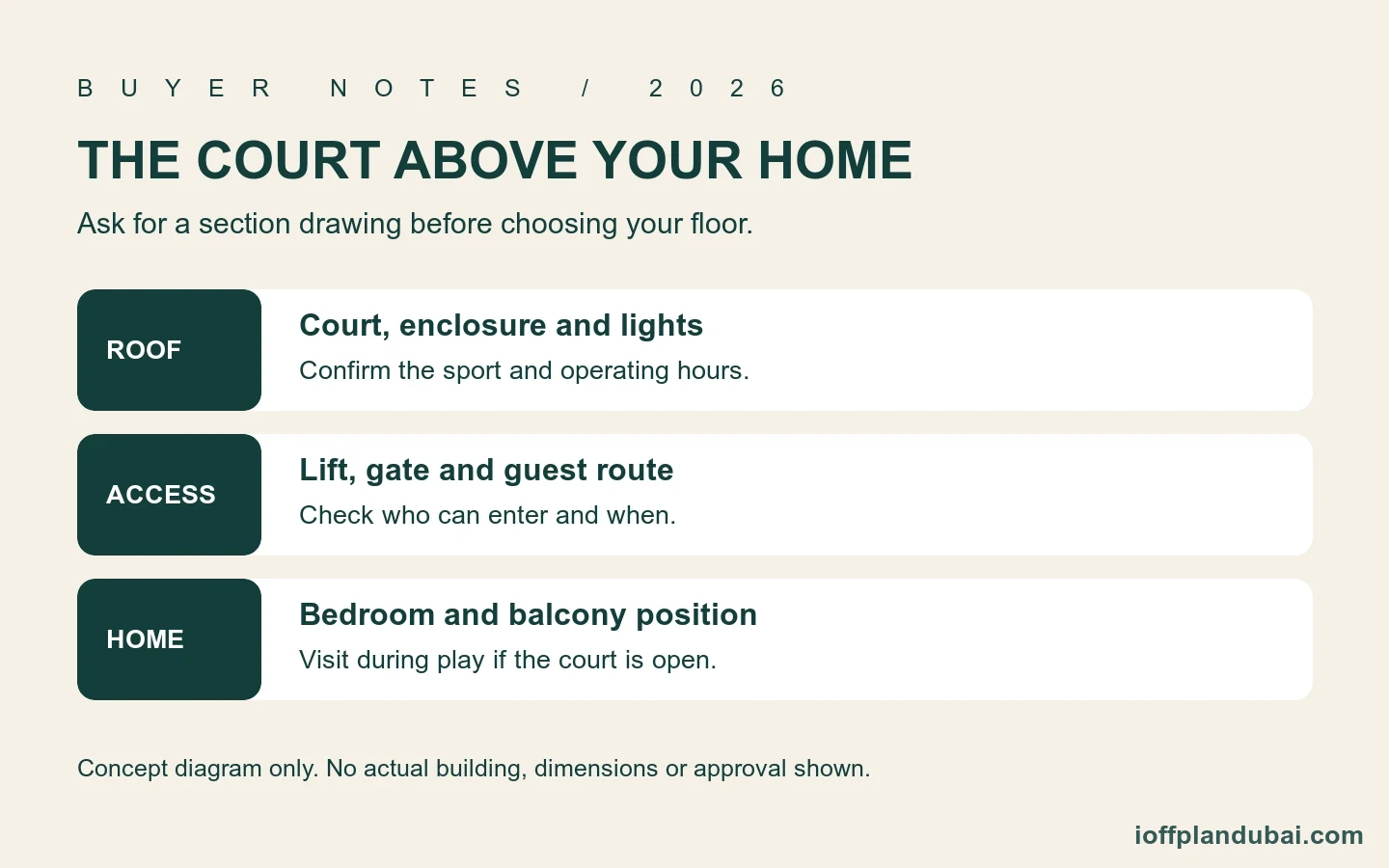
Request a section drawing that passes through the court and the apartment you're considering. A flat roof plan shows where the court sits horizontally. The section should help you understand the floors, rooms and other spaces between the playing surface and your home.
Mark the bedroom, balcony and home office on your apartment plan. Then ask the developer to show the court, gates, seating and lighting relative to those rooms. A roof court above another wing raises different viewing questions from one directly above your bedroom.
For an existing building, arrange a viewing while play is taking place. Listen from the rooms you'll use, with windows in their usual position. Look at the lights after dark and walk past the entrance where players gather. A quiet daytime viewing won't answer those questions.
For an off-plan home, ask what acoustic treatment and lighting controls appear in the specification. Have a suitably qualified adviser explain technical documents if these issues affect your choice. No sound level, lighting assessment or engineering approval for an individual building is supplied here.
The neighbour-noise guide explains factual reporting after moving in. Before buying, ask management how it handles court complaints and who can change the operating hours.
Will the court fit the times you actually play?
Write down your usual playing week before viewing. “Tuesday after work with three friends” is more useful than “regular access”. Ask the operator to explain how that session would be booked, how far ahead slots open and whether the limit applies to a person or a household.
Ask about wind, rain and heat closures, including who makes the decision and what happens to a paid booking. Check shade and lighting at your intended playing time. A roof photograph taken at sunset doesn't answer whether you would use the court at your normal hour.
For an operating court, request an anonymised booking demonstration. Look at your preferred time across more than one week and ask whether lessons or events reserve blocks of availability. Don't photograph another resident's account or personal details.
For a planned court, request the proposed timetable and identify who will issue the final rules. Treat the proposed hours as proposals. If a weekly game is central to your purchase, decide whether you would still want the home if those slots aren't available.
Can guests, children and tenants reach the roof?
Walk the route from the apartment door to the court entrance. Check whether the lift serves that level, whether there are stairs and where visitors enter. Ask about access cards, changing facilities and carrying equipment. Include the person whose mobility or access needs matter to your household.
Read the guest rule before assuming friends can join. Find out whether the resident must accompany them, whether guests pay separately and whether an outside coach can enter. A court you can book alone may still be unsuitable for your usual group.
Ask management for children's supervision rules and the process for reporting a damaged gate or enclosure. Safety and access details need the operator's written answer; a buyer's viewing isn't a technical inspection. Don't climb barriers or enter a closed roof to investigate.
If you plan to rent out the apartment, request the tenant-registration procedure. Confirm whether access transfers during the tenancy and whether the owner keeps any separate entitlement. Keep those rules with the home's documents so the tenant receives an accurate description later.
What will a rooftop court add to your annual costs?
Separate the building's annual charge from the price of playing. Request the current tariff in AED, its effective date and whether it applies per hour, session, court or player. Ask whether lighting, guest entry and equipment are included before comparing two homes.
Use the DLD Service Charge Index to check the relevant project, usage and budget year. DLD states that service charges exclude arrears. The index doesn't replace the operator's booking tariff, and no building-specific rate is quoted here.
Hypothetical example: your household pays AED 100 per session and books 36 sessions per year. AED 100 × 36 = AED 3,600 per year for bookings. If a different home costs AED 2,400 more annually but includes those same sessions, the assumed difference is AED 1,200 in favour of the inclusive arrangement. These are arithmetic assumptions, not Dubai prices.
The example only works if the sessions are available and the charges cover the same services. Keep your annual building charge in the comparison, then add separate usage costs once. Don't count included upkeep twice. Ask how replacement surfaces, lights and other shared equipment are reflected in the budget.
Read the service-charge bill guide beside the operator's answer. For an unbuilt facility, label estimates clearly and ask when a usable operating budget will be available.
Source · Dubai Land Department, Service Charge Index, undated service form · Checked 17 November 2026. No actual annual charge or booking price authenticated.
What should you get before paying an off-plan reservation?
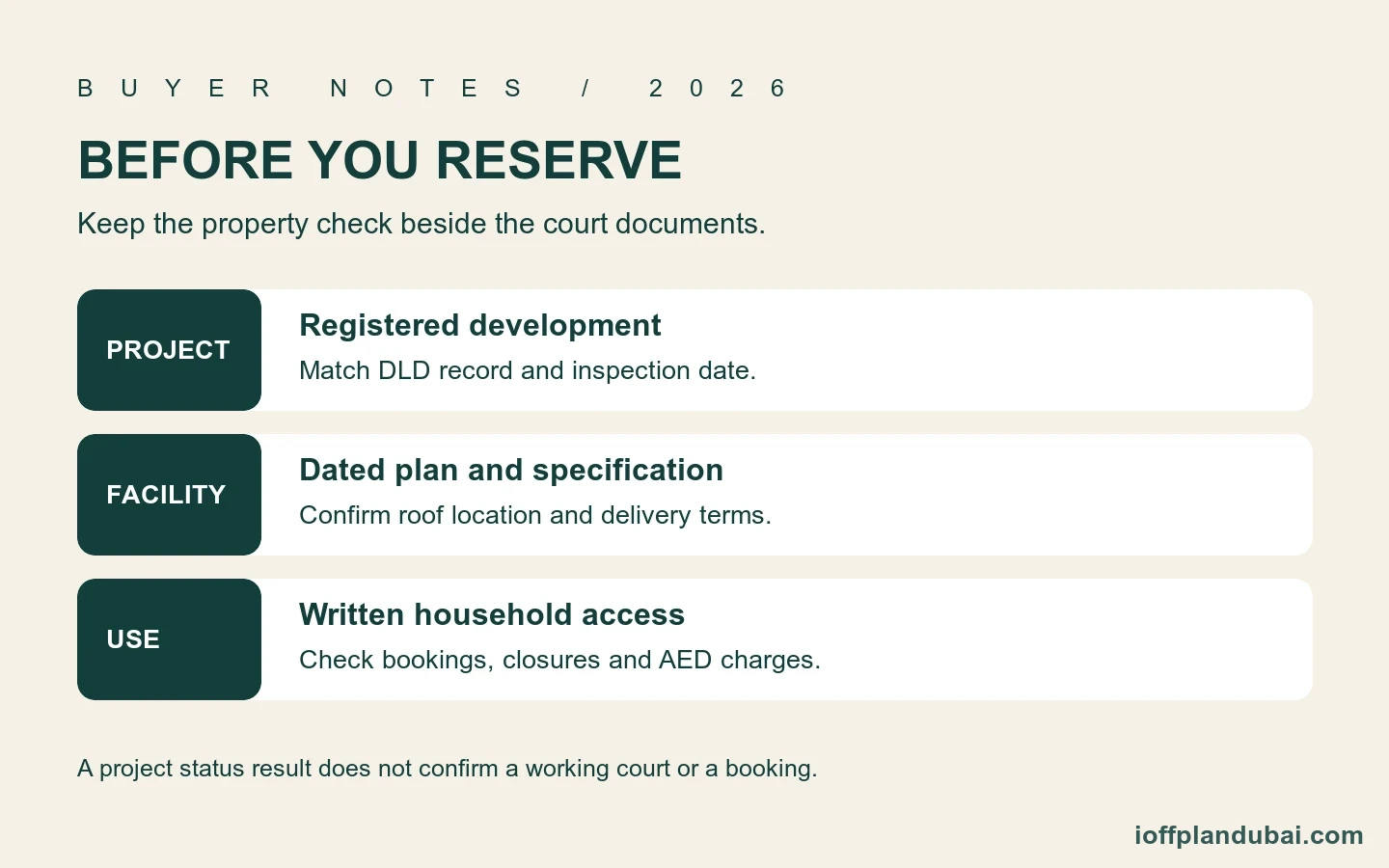
Keep the apartment reference and registered project name with the dated court specification. Ask where the court appears in the agreement or its annexes. Read the clauses covering changes to common facilities and delivery dates with the sale agreement checklist open beside you.
Open DLD Project Status Enquiry using the project name, project number or land number. Match the result to the development in your agreement and retain the date. A developer-reported progress figure isn't a DLD inspection, and neither proves the court is ready to book.
Ask separately when the apartment and the roof facility are expected to open. If those dates differ, find out how residents will be separated from ongoing works and how the roof will be accessed. Get a written explanation of what the agreement provides if the advertised facility changes or arrives later.
What to ask: “Please mark the court above this apartment on a section drawing, send the applicable access terms and show the relevant agreement annex.” Keep any unanswered point beside that document. Resolve it before treating the court as a reason to pay more for the home.
Source · Dubai Land Department, Project Status Enquiry, undated instructions · Checked 17 November 2026. No individual project result or facility opening is verified here.
FAQ
Does rooftop mean private use by the penthouse owner?
No ownership or exclusive access follows from that word. Ask whether the court is a common facility, a commercial venue or part of a particular property's documented rights. Get the applicable plan and access terms before assuming exclusivity.
Can you verify court safety from a brochure?
A brochure doesn't provide a technical inspection. Ask for the delivered specification and the operator's procedures. If the roof layout or condition raises questions, have a suitably qualified professional assess the relevant documents or facility before deciding.
Is a nearby rooftop venue a substitute for a resident court?
It can suit your routine if the journey, bookings and charges work for you. Check those directly with the venue. Buying nearby doesn't itself give you membership, priority or a discount. Keep the club cost separate from the home's annual bills.
Sources
- Emaar Entertainment — Zabeel Sports District — entertainment.emaar.com · checked
Announcement dated 11 January 2022 describes five panoramic padel tennis courts on the rooftop of Dubai Mall Zabeel. Historical commercial-venue example only; no current tariff in AED, opening status, booking availability or residential access right verified.
- Accor — Sofitel Dubai The Palm, Fitness and Leisure — sofitel.accor.com · checked
Undated operator page describes rooftop tennis courts, lighting and hire for hotel guests and Dubai residents for up to one hour per day; equipment charges are separate. No current tariff in AED or live booking authenticated. Venue access does not establish a property entitlement.
- Dubai Land Department — Project Status Enquiry — dubailand.gov.ae · checked
Official instructions accept land number, project number or project name and describe project completion information. No individual development result, inspection date, completion percentage or court opening authenticated.
- Dubai Land Department — Service Charge Index — dubailand.gov.ae · checked
Official form asks for project, usage and year and states that service charges exclude arrears. No building charge in AED per year or court tariff in AED per hour obtained. Keep area units and budget year with any quoted rate.
Next stepDue diligence →
More in Due diligence
Start here: Due diligence
- Floating cinema in Dubai: 7 checks before buying a home
- Lazy river apartments: 7 checks before buying in Dubai
- Padel courts in Dubai homes: access and buyer checks
- Freezone vs Freehold Property in Dubai (Buyer Guide)
- Government home buyer schemes in UAE (2026 Checklist)
- Escrow Account Transfer in Dubai: Steps (2026 Update)