E-trader licence in Dubai: steps, fees and checks (2026)
Get an e-trader licence in Dubai: official fees, activity and eligibility checks, application steps and permissions for working from your home.
To get an e-trader licence in Dubai in November 2026, start through Invest in Dubai: confirm your activity and eligibility, register the trade name, then complete the eTrader application. The government describes this as a home-based sole establishment; check that it fits what you'll actually sell before paying.
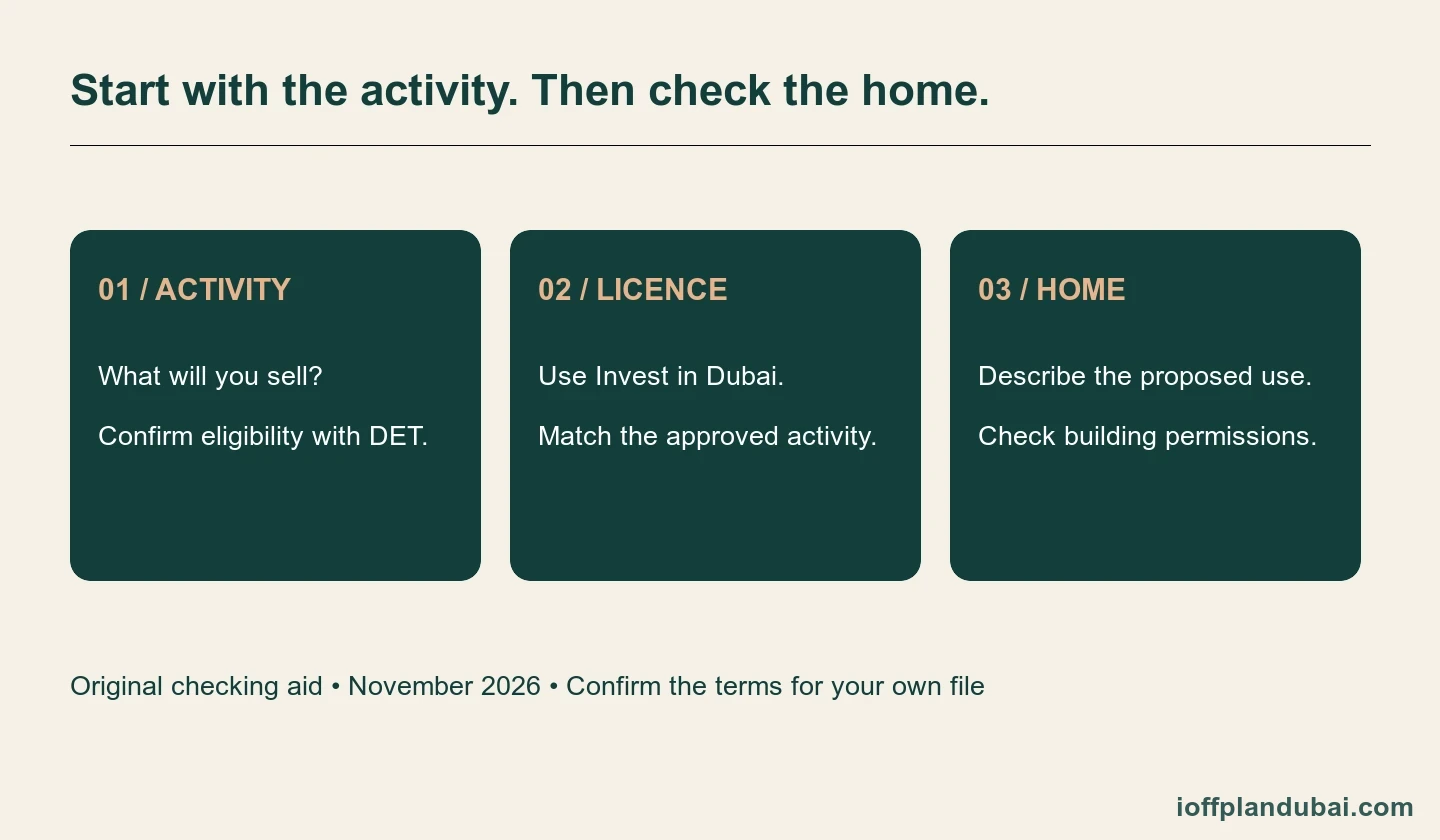
Have your ID number ready. If you're choosing a Dubai home partly because you plan to work from it, settle the business and building permissions before signing the tenancy or purchase agreement. A residential address and a business licence answer different questions.
Who can get an e-trader licence in Dubai?
Invest in Dubai's trade-licence service describes eTrader as a sole-establishment licence for Dubai home-based businesses with an issued trade name. Its document requirement is an ID number. The public service description doesn't give a complete nationality, age and activity eligibility table.
Ask the Department of Economy and Tourism (DET) to confirm your proposed activity against your nationality and residence status. Say exactly what you intend to do. “Sell finished candles online” gives the licensing team a different question from “design packaging for clients”. Don't select a vaguely similar activity just because the application offers it.
Before you apply, write down:
| Your information | What you need confirmed |
|---|---|
| Nationality and current residence status | Whether you qualify for this licence and activity |
| Exact goods or services | The activity name and code to select |
| One owner or several owners | Whether the sole-establishment form fits |
| Home address and planned use | What address evidence and permissions are needed |
| Website, marketplace or social account | Whether your proposed sales channels are covered |
Keep the reply with your application reference. A consultant's general eligibility chart isn't approval for your file.
Source: Invest in Dubai, trade-licence service; checked 18 November 2026. Individual eligibility remains subject to DET confirmation.
How much does the licence cost in 2026?
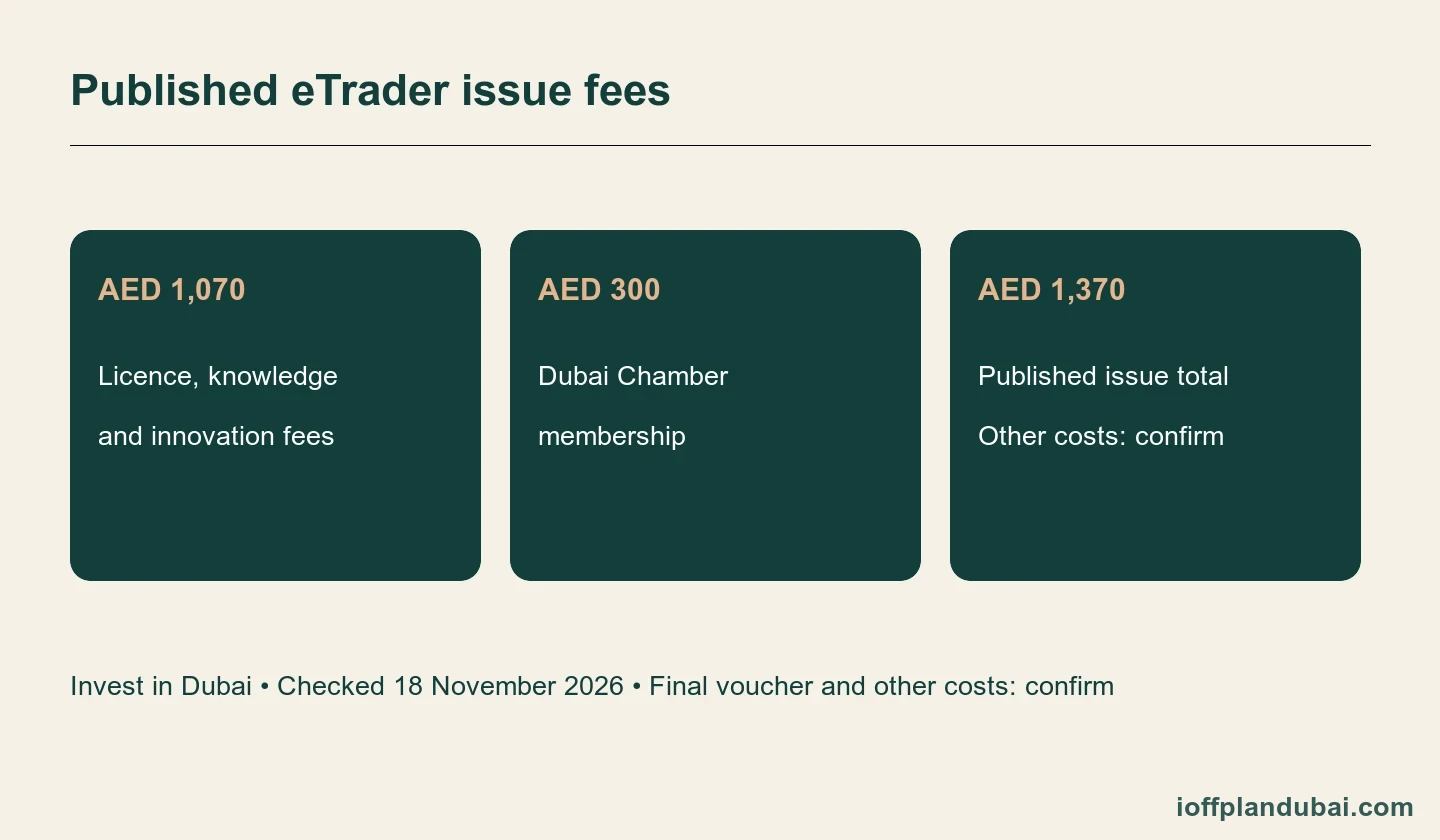
The same government service page publishes AED 1,070 for licence, knowledge and innovation fees, plus AED 300 for Dubai Chamber membership. Those two components add up to AED 1,370. This is the published issue-fee breakdown checked on 18 November 2026, rather than a quote for every business setup.
Ask for a payment voucher showing the charges for your actual application. Keep optional help, trade-name charges, external approvals and other services separate. If someone quotes a package, ask which government amounts it contains and what they charge for their own work.
Make a small first-year budget before committing to a home-based operation:
- Licence: the government voucher for your approved activity.
- Approvals: any separate permission the authority requires for your goods or service.
- Selling costs: your own platform, delivery and payment-provider quotations.
- Premises: any agreed storage or work-space cost outside your home.
- Renewal: a current renewal quote when due, rather than assuming the issue fee repeats.
Don't add a guessed “all-inclusive” total. The useful number is the sum of written charges you can trace to a provider and a date.
How do you apply through Invest in Dubai?
Open the government service page above and follow its Invest in Dubai portal link. Use that route rather than an old bookmark or an advertisement with a similar name. Use the application to check the requirements for your file.
- Describe the activity. Prepare one sentence explaining what you sell, how you deliver it and where you operate. Include physical goods even if you sell entirely through social media.
- Confirm the legal form. Check that a sole establishment matches your intended ownership. If you plan to add a partner, ask about the appropriate alternative before creating the file.
- Register the trade name. Check its spelling against your application. A social-media handle doesn't replace an approved business name.
- Enter the requested details. Keep your identity and address documents available, but upload only what the official application or authorised service centre requests.
- Resolve approvals. Ask about any regulator or product-specific permission before treating the licence as permission to launch.
- Review the voucher and licence. Match the name, activity, owner and address. Keep the issued document and the receipt together.
The service page advertises a five-minute completion time for an eTrader application. That isn't a promise that activity questions, external approvals or missing documents will be settled in five minutes. Allow time to resolve those before booking a launch date.
For the general mainland sequence, the UAE Government's business-setup guidance separates activity selection, legal form, trade name and any additional approvals. Don't assume every document listed for other company forms applies to eTrader.
Which documents should you prepare?
The eTrader service description specifically asks for an ID number. It doesn't publish a complete checklist for every applicant. Start with that confirmed requirement and ask for the remaining list against your activity.
As a preparation folder, keep your current identity document, address details, approved trade-name information and any written eligibility reply handy. These are sensible items to have available, not a claim that every one must be uploaded in every case.
If the application requests evidence of your Dubai address, use the document it names. Check that its unit number and address agree with the application. The Ejari renewal guide explains the tenancy registration task if you need to update a rental record first.
Ask which document is missing when a file is returned. “Address not accepted” could require a different document or a correction to the details. Paying someone to resubmit the same file won't resolve an unexplained mismatch.
Can you run the business from your apartment?
Ask your landlord or building management about the specific use you have in mind. Describe deliveries, stock, visitors, equipment and operating hours. Quiet desk work and daily customer collections create different practical demands on a residential building.
If you're buying off-plan, request the proposed community rules and ask how home-business use will be handled after handover. Put any promise that affects your purchase into the documents your adviser reviews. A showroom conversation doesn't tell management what it must permit later.
Use the sale and purchase agreement checklist to find the relevant property terms. For a rental, read the use clause before you sign. Don't assume ownership of the apartment removes building rules.
Ask management about:
- Visitors: will clients ever come upstairs, or collect orders at reception?
- Deliveries: how often will couriers arrive, and where can they wait?
- Stock: what will you store, in what quantity and under what conditions?
- Equipment: will the work create noise, odours, heat or extra electrical demand?
- Address: what business-address use does the landlord or management permit?
Take the remote-worker area guide as a way to compare daily working needs. A convenient neighbourhood still needs a suitable apartment and permission for your proposed use.
What can you sell online?
Check the activity on the issued licence against your actual goods and services. A website is a sales channel; it doesn't explain whether you're selling food, cosmetics, design work or another product. Ask about product approvals and regulated work separately.
The UAE Government's eCommerce guidance says online traders need the appropriate licences and approvals. It covers physical goods and digital products sold through websites, apps, social platforms and marketplaces. It also identifies TDRA approval within the mainland eCommerce framework; ask how that is handled for your application.
Hypothetical example: you plan to sell printed home-accessory designs, then later hold imported stock in your apartment. Before adding stock, explain the changed operation to DET and building management. Ask which activity, approvals and premises arrangements cover it. Don't assume the first licence automatically covers the second business model.
If the work involves property services, check the separate requirements in the Dubai real-estate licensing guide. An online business licence alone doesn't establish that you're authorised to carry out regulated real-estate work.
Source: UAE Government, eCommerce guidance, page updated 30 April 2026; checked 18 November 2026.
What should your online shop show customers?
Prepare the customer information before taking orders. The UAE Government's consumer-protection guidance says eCommerce businesses must provide licensing-entity details and Arabic information about the product or service, specifications, contract terms, payment and warranty. It also describes the supplier's invoice and privacy duties.
Build a sample order from the customer's side. Can they see who they're buying from, what they'll receive, when you'll deliver and how to report a problem? Check that the invoice uses the same trade name as the licence.
Write delivery and returns terms that fit your actual operation. If a courier collects only on particular days, don't promise immediate dispatch. Avoid publishing your private identity documents as proof of legitimacy; provide the business details customers need.
Keep customer records in the tools you actually use to fulfil orders. Before adding a marketing form, decide what information it needs and how you'll meet the applicable privacy requirements.
How do renewal, staff and visas work?
Check the expiry date on the issued licence and ask DET for its current renewal process and charges. The issue-service page isn't a verified renewal tariff. Keep the confirmation with your licence so you don't rely on an old message or a third-party reminder.
Don't budget for staff visas or your own residence permission until the relevant authority confirms your route. The service page describes different features for different licence types; benefits listed under its instant-licence section should not be copied across to eTrader.
If you need partners, a shop, employees or dedicated storage, describe those needs together when asking about alternatives. Compare the permission each route gives you before comparing its price. A cheaper licence that doesn't cover the operation won't solve the setup problem.
FAQ
Can expatriate residents apply?
Ask DET to confirm your nationality, residence status and exact activity together. The current public eTrader issue-service page doesn't provide a complete eligibility table. We haven't verified an individual expatriate application, so a general yes would promise more than the evidence supports.
Is an e-trader licence the same as a residence visa?
Don't treat them as interchangeable. Obtain written confirmation of any residence or employee sponsorship route you need. The public eTrader service description doesn't establish a visa entitlement for your business.
Do you need to rent an office first?
The government describes eTrader as home-based. Confirm the address evidence for your application and your building's permission for the proposed use. Don't sign an office lease simply because a generic company-setup checklist mentions one.
What if the portal doesn't offer your activity?
Keep the activity name and the message shown, then ask DET or an authorised service centre which route fits. Don't choose an inaccurate activity to get past the form. Resolve the permission before buying stock or committing to premises.
Sources
- Invest in Dubai — Request to issue a trade licence — investindubai.gov.ae · checked
Home-based sole establishment, trade name, ID number, portal and service-centre channels. Published issue fees AED 1,070 plus AED 300 Chamber membership, total AED 1,370; advertised five-minute service time is not an end-to-end approval guarantee. Full nationality/activity eligibility and renewal tariff not established.
- UAE Government — eCommerce — u.ae · checked
Page updated 30 April 2026. Appropriate licences and approvals, online sales channels, TDRA approval framework and trader responsibilities. No individual eligibility approval verified.
- UAE Government — Consumer protection — u.ae · checked
Licensing-entity details, Arabic product and contract information, dated invoices and consumer privacy duties.
- UAE Government — Steps to start a business on the mainland — u.ae · checked
Page updated 16 July 2026. Activity, legal form, trade name and additional approvals treated separately; generic company documents not imposed on every eTrader applicant.
Next stepBest places to work remotely in Dubai (4 Area Checks) →
More in Living in Dubai
Start here: Best places to work remotely in Dubai (4 Area Checks)
- Pool deck with private loungers in Dubai: whose seat is it?
- Public Buses in Dubai: Routes, Fares and Times (2026)
- Dubai Golden Visa Property Rules: AED 2M and Off-Plan (2026)
- Upcoming attractions in Dubai and what’s already open
- Co-living in Dubai: room permits, rent and lease terms
- Top Interior Design Companies in Dubai: 5 Firms Compared