Elevator checks for Dubai apartments before you buy
Elevator checks for Dubai buyers: test the route from parking, ask about lift traffic and maintenance, and check private access before paying.
An elevator label tells you a Dubai building has a lift; it doesn't tell you which floors it serves or how well the route works. As of 17 November 2026, check the journey from your parking space to your front door, then ask for maintenance records and the costs you would share.
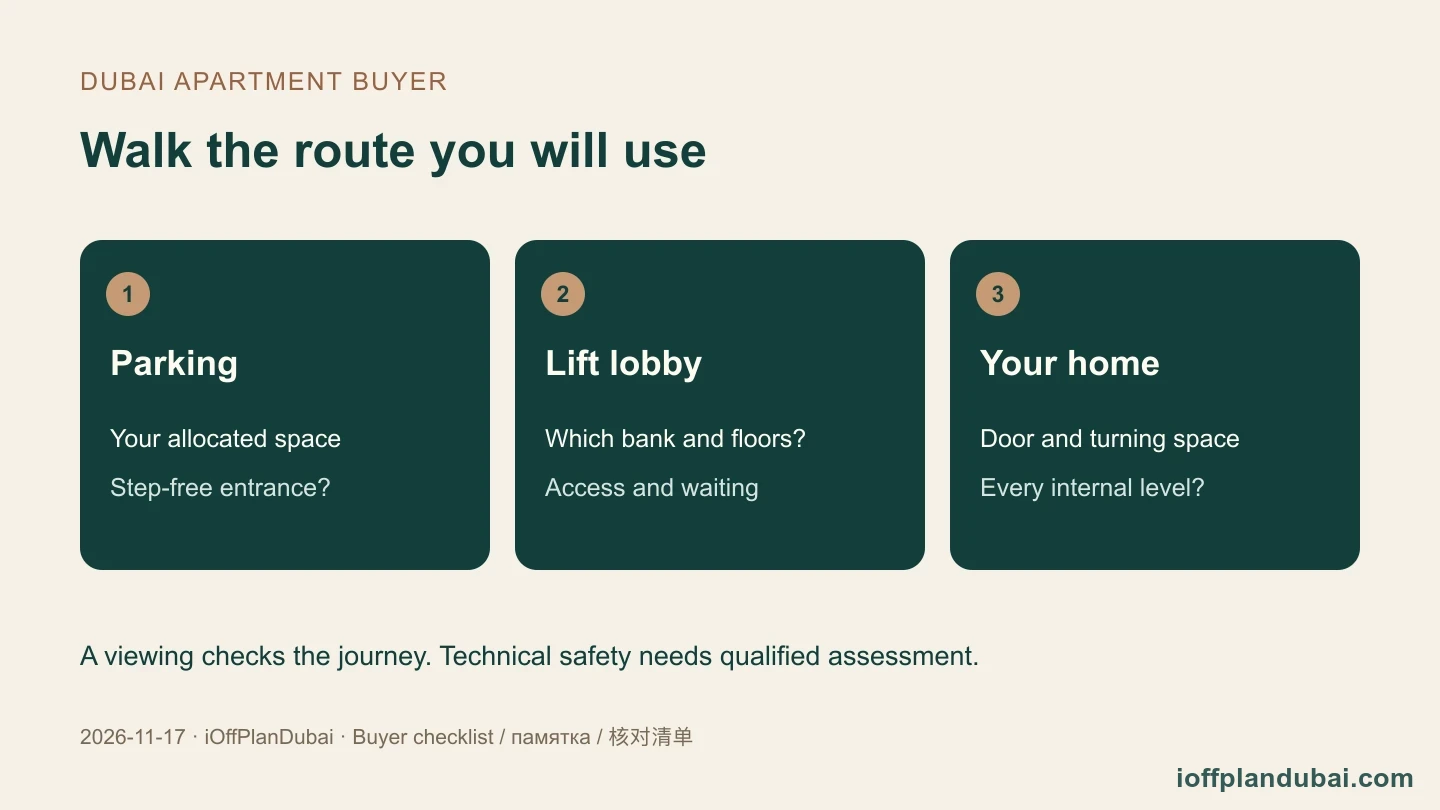
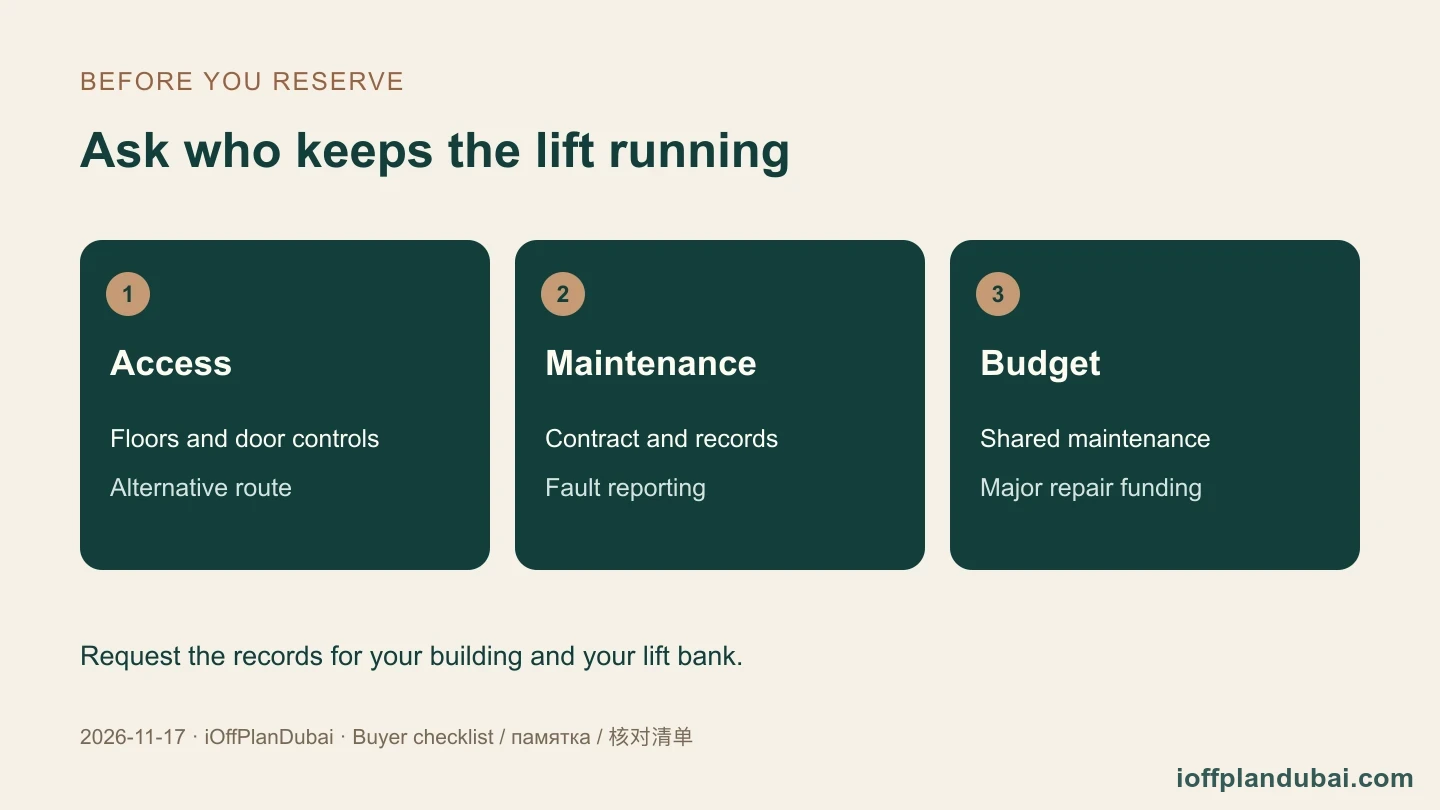
For an off-plan apartment, request the relevant drawings and written specification before paying. For a completed home, walk the route yourself. A private lift entrance deserves the same scrutiny as a shared lobby: access controls, breakdown arrangements and maintenance still matter.
Which elevator checks should come first?
Start with your actual journey. Identify the allocated parking level, the lift bank serving your apartment and any change of lift on the way. Ask whether your access card reaches the gym, pool and visitor entrance too.
Note the route and any access restrictions while viewing. You don't need to diagnose machinery. Check whether your household can use the route, then ask management about anything you cannot confirm on the visit.
| Check | What to do | What to request off-plan |
|---|---|---|
| Parking to home | Walk the entire route | Marked parking and circulation drawings |
| Step-free access | Look for steps, thresholds and heavy doors | Accessible route and door information |
| Daily traffic | Observe the relevant lift bank | Traffic assessment assumptions |
| Deliveries and moves | Ask which lift and entrance are used | Written moving and delivery arrangements |
| Breakdowns | Ask what alternative route remains | Maintenance and emergency arrangements |
Keep this alongside the built-up area guide. A large floor area doesn't tell you how a wheelchair, pram or piece of furniture reaches the apartment.
How many lifts does an apartment building need?
There isn't one number you can apply to every Dubai tower. Part D of the Dubai Building Code sets out prescriptive and performance-based approaches to lift provision. The relevant design depends on the building and its use.
Ask the developer which lifts serve your floor and what assumptions support the design. A total count in a brochure can include lifts serving another tower, a hotel or a separate group of floors. Request a diagram that identifies your bank.
For a completed building, visit when residents are likely to be travelling. Note the time, which lift bank you used and whether all cars were operating. Your observation describes that visit; it doesn't establish a building-wide average or technical compliance.
If waiting time could affect your decision, make it a specific question: “What traffic study covers this residential bank, and what occupancy did it assume?” Ask a qualified consultant to explain the answer if it is material to your purchase.
Will the lift work for a wheelchair or pram?
Trace the full route, including the pavement, reception and parking entrance. A usable cabin is only one part of access. A step before the lobby or a narrow turn after the lift can change the journey.
Part C of the building code addresses accessible elevators, with technical conditions and exceptions. Avoid treating a general rule as proof that a particular home is suitable. Ask for the dimensions and route relevant to your needs, then have them checked where necessary.
Dubai Municipality describes Wosool assessment services for existing buildings. These include site assessment reports and a classification certificate following final assessment. If a seller mentions a certificate, ask to see it and check which building and scope it covers.
Bring the measurements of the mobility equipment or pram you actually use. Check the clear door opening, cabin arrangement and space to turn outside. Don't obstruct doors or try to test safety devices during a viewing.
What does private lift access really include?
Ask the seller to mark the route on your apartment plan. “Private access” might describe where the doors open, the floors your card allows or a dedicated lift arrangement. The phrase alone doesn't settle which equipment is shared or who can reach the lobby.
Check visitor access, staff access and what happens when your access card is lost. Ask where a delivery waits and how a guest reaches you. These details matter particularly when the lift opens into an entrance area within the home.
For a duplex or larger residence, find out whether the lift serves every internal level. The triplex buyer guide helps you compare the internal stairs with the lift route. Don't assume that direct arrival on one level makes the whole home step-free.
Request written responsibility for the cabin, access controls and equipment serving your home. If a lift is described as exclusive, ask who can authorise maintenance, where the technician enters and who pays for a major repair.
What should you ask about maintenance and breakdowns?
Ask building management for the maintenance provider, the current contract scope and recent service records for the relevant lift bank. Request a summary without residents' personal details. A maintenance logo in the lobby doesn't explain the work covered.
Ask how faults are reported and how residents receive updates. Useful records identify the affected lift, the reported problem, the response and the work completed. Repeated visits need an explanation; they don't, by themselves, establish a technical defect or its cause.
Check whether another lift can serve your floor during an outage. A service lift might have different access or operating arrangements. Ask management to describe the route rather than assuming every lift is interchangeable.
The building code covers installation, testing, commissioning and maintenance. We haven't verified one inspection interval that applies to every residential lift. Ask management and the relevant authority what applies to the particular equipment and building.
What happens during a power cut or emergency?
Ask management to explain the building's approved emergency arrangements and the information given to residents. Request the route from your floor, the assembly point and arrangements for someone who cannot use stairs independently.
Article 8 of Dubai's 2026 public safety law addresses lift installation alongside occupied-building safety and emergency evacuation requirements. It doesn't certify your building or tell you that a particular lift remains available in an emergency.
Don't infer backup operation from a generator being present. Ask which equipment it serves and what the approved operating arrangements are. Have management explain any designated emergency lift and who is authorised to use it.
The Dubai home emergency preparation guide helps you gather the household information before an incident. Keep the building's instructions somewhere everyone in the household can find them.
How do lifts affect the service charge?
Ask for the building's current approved budget and the basis used to allocate shared expenses. Find out where lift maintenance, electricity and major repairs appear. A single annual figure doesn't explain what is included or which costs could be charged separately.
For an off-plan home, label the budget as an estimate unless it has the relevant approval. Ask who produced it, its date and the area measure used. Compare the same period and unit of measurement across buildings.
Use the Mollak service-charge guide to follow the wider budget checks. Request the actual building records rather than a fee copied from a nearby development.
Hypothetical comparison: a household making four return journeys a day uses the lift eight times. Over seven days that is 56 one-way trips. This isn't a traffic forecast; it shows why the everyday route deserves a viewing, even when a home has an impressive interior.
What changes when the apartment is off-plan?
You can't test a lift that hasn't been commissioned. Ask for the planned lift bank, served floors, accessible route and specification instead. Identify which details are contractual and which appear only in an illustration.
Write down any feature that affects your decision: direct access, a separate service route or access to every level of a duplex. Ask the developer where it appears in the agreement and what the contract allows to change.
Before handover, request the documents applicable to the completed installation and the management contact for reporting faults. Arrange a qualified inspection for technical questions. A buyer's checklist cannot establish the condition of lift machinery.
At the viewing or handover, record a simple mismatch precisely: “The drawing shows access from parking level B2; please show the completed route.” That is easier to resolve than a general complaint that the lift isn't as expected.
FAQ
Is a lift count enough to compare two buildings?
No. Check which cars serve your apartment, how the floors are divided and whether deliveries share the same bank. A tower-wide total can hide separate arrangements for homes, hotel rooms or other uses.
Does a private entrance mean the lift belongs to me?
Ask for the ownership and maintenance documents. An entrance arrangement doesn't establish equipment ownership, exclusive use or who pays for repairs. Put those questions to the developer or building manager before signing.
Can I check accessibility at a viewing?
You can walk the route and record dimensions relevant to your household. Formal compliance and equipment safety require the appropriate documents and qualified assessment. Ask for any claimed accessibility certificate and check its scope.
What should I request before reserving an off-plan apartment?
Ask for the drawings serving your unit, the lift specification, the planned maintenance arrangements and a dated service-charge estimate. Keep the developer's written answers with your agreement so you can compare them with the completed home.
Sources
- Government of Dubai — Dubai Building Code, 2021 edition — web.khda.gov.ae · checked
Parts C and D cover accessibility and vertical transportation, including design approaches, commissioning and maintenance. The code has exceptions and technical conditions; no specific building is certified here.
- Dubai Municipality — Dubai Universal Design Code — dm.gov.ae · checked
Describes Wosool preliminary and final assessments for existing buildings, including site reports and classification certificates. No inspection or certification of an individual property obtained.
- Dubai Legislation Portal — Law No. 2 of 2026 concerning public safety — dlp.dubai.gov.ae · checked
Article 8 addresses elevators and escalators in occupied buildings, stairs and emergency evacuation requirements. No universal inspection frequency, residential waiting-time limit or lift fee inferred.
Next stepDue diligence →
More in Due diligence
Start here: Due diligence
- Sky Palace in Dubai: plans, ownership and costs 2026
- Triplex properties in Dubai: plans and costs (Checklist)
- Easement disputes in Dubai: access rights (Checklist)
- Floating cinema in Dubai: 7 checks before buying a home
- Lazy river apartments: 7 checks before buying in Dubai
- Padel courts in Dubai homes: access and buyer checks