Dubai property preparation for natural disasters: 2026
Prepare your Dubai home for heavy rain, power cuts and tremors. Get the building plan, check maintenance and confirm insurance before trouble starts.
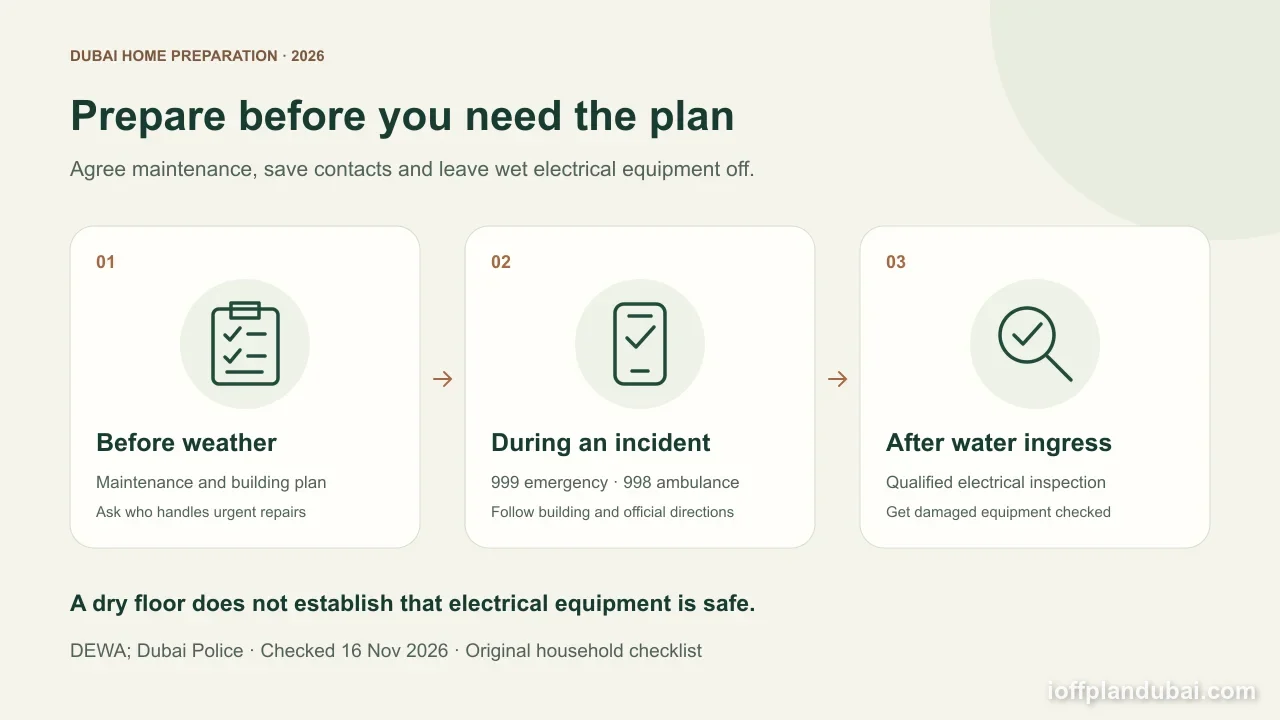
Prepare your Dubai home before bad weather: ask management for the emergency plan, arrange an electrical check and keep repair contacts where everyone can find them. If water reaches electrical equipment, don't switch it back on. For immediate danger call 999; for an ambulance call 998.
What should you arrange before heavy rain?
Ask your building's maintenance team to check rainwater drainage, roof and terrace outlets, and any known leak repairs. For a villa, agree who will arrange the work before the next weather warning. Ask the provider to identify unfinished work and give you a repair date.
DEWA advises using a qualified electrical technician to secure distribution boards and meter boxes, repair damaged covers and seal unused cable openings. Leave electrical work to the technician.
| Ask management or your maintenance provider | Keep |
|---|---|
| Which drains and outlets were checked, and when? | Dated maintenance record and unresolved defects |
| Who handles leaks outside office hours? | Duty contact and reporting route |
| What happens if the basement or car-park ramp floods? | Building instructions and safe alternative access |
| Who checks pumps and backup equipment? | Inspection and test records, with outstanding work |
Buying a home? Use the pre-purchase inspection guide to request a scope covering visible water ingress and any further investigation recommended by the inspector. The snagging guide helps you agree access and testing limits.
Source · DEWA, rain and extreme weather guidance, undated · Checked 16 November 2026. Drainage and building-record questions are our preparation checklist.
What should your household plan include?
Get the building's evacuation plan and assembly point from management. Walk the route while conditions are normal. Ask how someone who needs assistance will be helped and how residents receive urgent instructions.
Keep a torch, charged phone and power bank accessible. Save the duty contact offline, along with your home address, building entrance and apartment number. Give visiting family the same information.
For renters, ask the landlord who authorises urgent repairs and where to send reports. The owners' association and management guide helps you identify the building contact. Keep private documents and access codes out of residents' group chats.
Emergency contacts · Dubai Police lists 999 for emergencies, 901 for non-emergency inquiries, 998 for ambulance and 997 for Civil Defence. A maintenance request belongs with management unless there's an emergency.
Source · Dubai Police, rainfall safety advice, 31 March 2026 · Checked 16 November 2026. Household planning steps are our checklist; request your building's own instructions.
What should you do when water enters the home?
Stay away from wet electrical equipment. Don't operate appliances exposed to water, even after the floor looks dry. Report the location to maintenance without entering standing water to reach a switch or appliance.
DEWA directs internal electrical faults to a specialist technician or building maintenance. If the cause of an outage is unclear, use Smart Response through DEWA's digital channels or DubaiNow. Moving into the home? Use the DEWA application guide.
Outside, follow police closures and instructions. Dubai Police warns against crossing valleys and water channels during rain. Don't make a journey through floodwater to inspect a property.
Sources · DEWA, outages and wet equipment · Dubai Police, rainfall advice · Checked 16 November 2026.
What if you feel an earthquake in an apartment?
Drop, cover and hold on. In a high-rise, stay inside during shaking, move away from windows and outside walls, and don't use lifts. Take cover under a sturdy table if one is nearby.
NCEMA also warns about glass, shelves and falling objects, and possible gas leakage. Avoid flames if a leak is suspected. Follow emergency services' instructions and the building's evacuation directions when it is safe to move.
Ask management how it checks the building after an incident. A recent paint job or an undamaged lobby doesn't establish the condition of the structure.
Sources · CDC, earthquake safety · NCEMA, natural disasters and power outage guide · Checked 16 November 2026.
What should you check before buying or renewing insurance?
Ask the seller or landlord for previous water-ingress reports, repair invoices and any outstanding investigations. Send those to your inspector. Before paying for a property, ask what remains unrepaired and who will complete the work.
Send the insurer a specific question: “Does this policy cover rainwater entering this apartment, damage to my belongings and temporary accommodation?” Request the relevant clauses, exclusions, excess in AED per claim, limits in AED and notification deadline. Coverage and premiums remain specific to the policy; ask the insurer to confirm the cover for this home.
Ask management separately what the building policy covers and what owners or tenants need to arrange themselves. Keep this with the maintenance budget, using the service-charge guide to check what shared charges include.
Watch out: paying a service charge doesn't tell you whether your belongings or temporary accommodation are insured. Get the policy wording before relying on either.
When checking access during an outage, use the apartment elevator guide to ask management which lifts serve your floor and what the approved emergency arrangements require.
FAQ
Can you restart wet equipment once it dries?
Don't use appearance as the test. DEWA says not to operate equipment exposed to water and recommends a qualified technician's post-rain inspection. Ask the technician to confirm what is safe to use and what still needs repair.
Does an upper-floor apartment need preparation?
Yes. Ask about the apartment's windows and terrace, shared services and the route out of the building. Floor height alone doesn't answer those questions. Request the home's repair history and the building's emergency instructions.
What should you record after damage?
Once it is safe, keep dated photographs, the maintenance reference and repair correspondence. Ask your insurer what evidence it needs before disposing of damaged items or authorising non-urgent work. Don't delay emergency help to take pictures.
Put the building's duty number and household plan somewhere everyone can reach today.
Sources
- Dubai Electricity and Water Authority — rain and extreme weather guidance — dewa.gov.ae · checked
Official advice covers qualified-technician preparation, internal electrical faults, Smart Response and post-rain inspection. Do not operate equipment exposed to water. No household inspection or restoration time established.
- Dubai Police — rainfall safety advice, 31 March 2026 — dubaipolice.gov.ae · checked
Official advice warns against crossing valleys and water channels and confirms 999 emergencies, 901 non-emergency inquiries, 998 ambulance and 997 Civil Defence. Telephone numbers, not repair or response-time guarantees.
- National Emergency Crisis and Disaster Management Authority — natural disasters and power outage guide — ncema.gov.ae · checked
National emergency guidance includes earthquake precautions around windows, glass, shelves and possible gas leakage. No Dubai property-specific structural assessment or disaster probability established.
- US Centers for Disease Control and Prevention — earthquake safety — cdc.gov · checked
Government safety guidance says drop, cover and hold on, move away from windows and outside walls in high-rise buildings and do not use elevators during shaking. General safety guidance, not a Dubai building certification.
Next stepBest places to work remotely in Dubai (4 Area Checks) →
More in Living in Dubai
Start here: Best places to work remotely in Dubai (4 Area Checks)
- DEWA application: utilities setup and fees in 2026
- Makani Real Estate and Al Ain Mall: 2026 update
- Dubai cycling routes: tracks and rules (2026 Update)
- Pet registration Dubai: documents (2026 Checklist)
- Dubai Water Canal living: pros and cons (Checklist)
- Top interior design companies in Dubai: 5 to compare