Defect liability period Dubai: 1-year and 10-year rules
Defect liability period Dubai explained: installations, structural defects, start dates, reporting evidence and where owners or tenants can ask for help.
The defect liability period Dubai owners usually mean is one year: the developer must repair or replace defective installations in jointly owned property for a year after handing over your unit. Article 40 of Dubai Law No. 6 of 2019 separately makes the developer liable for defects in structural parts for ten years, starting from the project's completion certificate. Ask for the start dates and report faults through the developer's recognised channel now.
The one-year installations period normally starts at unit handover. If the owner refrains from taking possession, Article 40 says it starts from the project completion certificate instead. Ask for both documents before relying on a warranty-expiry message.
What is the defect liability period Dubai law gives owners?
Start with Article 40 of Dubai Law No. 6 of 2019. It concerns developer liability in jointly owned real property. Ask DLD or your lawyer to confirm the property's legal regime if you're unsure.
| Published obligation | Period | Starting event |
|---|---|---|
| Repair or replacement of defective installations, including mechanical, electrical, sanitary, sewerage and similar installations | 1 year | Handover of the unit to its owner |
| Installations where the owner refrains from taking possession | 1 year | Obtaining the project completion certificate |
| Remedy or rectification of defects in structural parts | 10 years | Obtaining the project completion certificate |
These are liability periods, not promises to complete every repair within one year of your report. Ask separately for an inspection appointment and repair programme.
Article 40 also preserves other statutory rights and warranties. It says agreements made after the law took effect that contradict the Article are void. Have your lawyer assess any release or conflicting clause before you sign it.
Source · Dubai Supreme Legislation Committee, Law 6 of 2019, Article 40 · Checked 17 November 2026. Arabic governs interpretation.
Which dates should you request at handover?
Ask the developer for the project completion certificate, your unit handover record and its written explanation of the defects-reporting period. Keep the actual documents beside the date list. The handover notice checklist shows where these dates fit among the other checks.
Use the building completion certificate checklist if you need to match the certificate to your tower before you record its date.
Put these dates on your handover sheet:
- Project certificate: issuing authority, certificate reference and date obtained.
- Unit handover: signed record, unit number and date.
- Possession: any notice or correspondence explaining why possession hasn't been taken.
- Developer policy: document version, start event, stated end date and reporting channel.
- Product warranties: equipment details, supplier and the start date stated on each warranty.
If an expiry notice arrives earlier than expected, ask for the document and clause behind it. Your move-in date may be later than the event the notice uses.
Hypothetical example: a project certificate predates your unit handover. Put both dates in the file and ask which applies to the specific defect. Don't add ten years to the move-in date or assume delaying key collection gives you a new installations period.
Use the property purchase agreement checklist to find the notice, handover and defects clauses. An unfamiliar start-date label deserves a written explanation before you rely on it.
Does the one-year rule cover every snag and repair?
Article 40 names defective installations. Don't turn that wording into a promise that every scratch, appliance failure or maintenance visit is covered. Ask the developer to identify the applicable obligation and explain any refusal item by item.
Emaar's August 2020 factsheet, still linked from its current FAQ when checked, illustrates the distinction. It describes electrical, plumbing and cooling-system workmanship defects, building-envelope water penetration and certain cladding defects. It also tells owners to record cosmetic surface damage during Home Orientation.
The same factsheet excludes normal wear, misuse, improper maintenance and purchaser-supplied work, among other items. Those are Emaar's published policy terms; ask for the current version applying to your unit. Don't apply them to another developer or treat them as a legal ruling on your fault.
Its policy starts the one-year period at Snag Completion or Contract Completion Date, whichever is later. That wording needs checking against your documents and the statutory rule above. Ask your lawyer to explain any difference rather than choosing whichever date seems more convenient.
| What you've noticed | What to request |
|---|---|
| Water staining beneath a window | Inspection findings, cause and the proposed repair |
| Cooling stops working | Equipment and installation checks, plus maintenance history |
| Scratched door at orientation | A dated entry on the orientation list and photograph |
| Crack in a wall or column | A qualified assessment of the affected element and cause |
| Appliance failure | Warranty document and confirmation of the correct service route |
Describe the symptom and ask for its cause to be assessed. A water stain or crack alone doesn't establish who must pay.
Source · Emaar Properties, Preventive Maintenance and Defect Warranty Period, August 2020 version · Checked 17 November 2026.
How do you report defects so they can be followed up?
Use the developer's customer-care or property-quality channel and ask for a reference number. Emaar's FAQ describes recording Home Orientation observations on a checklist, with a separate Property Quality Assurance route after handover. Confirm your own developer's procedure. At the first visit, use the room-by-room snagging checklist to record what you could test and where you still need access.
For each item, provide:
- Location: “main bedroom, window beside the balcony door”.
- Observation: what you saw or what failed, without guessing the cause.
- Date: when first noticed and when reported.
- Evidence: a clear photograph, inspection finding or relevant handover entry.
- Access: when the developer can inspect and who will admit the technician.
Hypothetical report: “Item 07: water staining below the main-bedroom window, first noticed 17 November. Photos attached. Please inspect, confirm the cause and give an appointment reference.” That gives the team something it can find and respond to.
Ask for acknowledgement and keep the original submission, attachments and reply together. If you speak by phone, follow up through the required written channel. Emaar's older factsheet specifically excludes items not reported in writing within the applicable warranty period.
For an independent visit, use the inspection scope checklist and confirm access, working utilities, report scope and return-visit terms. Don't assume an inspector's email automatically becomes a developer service request.
Sources · Emaar Properties, Home Orientation and post-handover FAQ and written-reporting factsheet · Checked 17 November 2026.
What if the developer marks a repair complete but the fault remains?
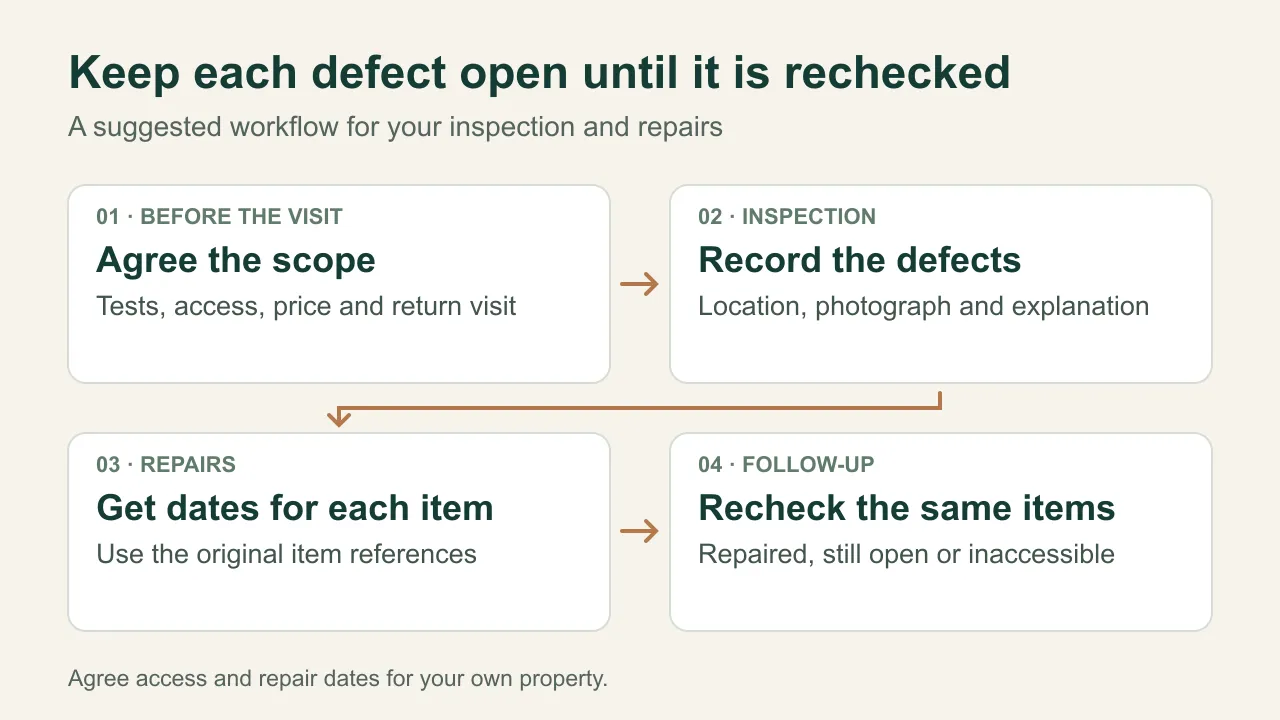
Keep the original defect number. Add the repair visit date, what was done and what you found when you checked it again. Ask the developer to reopen the item or connect the new ticket to the original report.
Track the reply beside the original report:
| Item | First report and reference | Latest response | Next action |
|---|---|---|---|
| Your defect number | Date, channel, acknowledgement | Inspection finding or repair note | Appointment, recheck or written explanation |
Photograph the same location after the repair. If the team replaced a component, ask for the work order and any new warranty document. Keep “work carried out” separate from “fault no longer observed”.
If you're told someone will come back, ask for an appointment date, the access needed and a named contact. We couldn't find an official deadline for a developer to finish a repair.
If an expiry date is approaching while an item remains open, obtain advice on preserving your position. A service ticket doesn't by itself establish that every legal notice or filing requirement has been met.
How is the ten-year structural rule different from federal decennial liability?
The Dubai rule above concerns the developer and structural parts of jointly owned property. Federal construction-contract liability raises separate questions about the contractor, engineer, claimant and applicable law. “Decennial” simply means ten-year; the label doesn't identify the correct defendant or filing deadline.
Don't rely on an older guide's federal article numbers without checking them. WAM announced a new Civil Transactions Law on 1 January 2026. Its official English text, Federal Decree-Law No. 25 of 2025, is on the UAE Legislation site, which lists an effective date of 1 June 2026.
In that text, Article 821 makes the contractor and the engineer who designed and supervised the work jointly liable for ten years for a total or partial collapse, and for defects that threaten the building's structural integrity and safety. The period starts when the employer takes delivery of the work. Article 824 says a warranty claim isn't admissible more than three years after the collapse or the discovery of the defect.
WAM's official announcement of the new Civil Transactions Law also reports changes to contracts of works and latent-defect sale claims. We couldn't confirm how the new law applies to buildings finished before it took effect. Ask your lawyer to check the Arabic law against your contract and event dates.
So a ten-year liability period doesn't mean you can wait ten years after discovering a fault. Ask specifically about the filing deadline, notice requirements and which parties a claim can involve. Report a suspected structural problem promptly and arrange a qualified assessment.
Sources · WAM, new Civil Transactions Law announcement, dated 1 January 2026 · UAE Legislation, Federal Decree-Law No. 25 of 2025, Articles 821–824 · Checked 18 November 2026. Arabic prevails.
What should tenants and owners do about maintenance?
If you're renting a newly handed-over home, tell the landlord and building management about the fault. Ask who will open the developer request and arrange access. Use the landlord and tenant maintenance checklist to prepare the fault report and check repair approvals. Keep the tenancy maintenance clause with the correspondence.
Article 16 of Dubai's published tenancy law makes the landlord responsible for maintenance and defects affecting the intended use, unless otherwise agreed. Article 19 addresses the tenant's care of the home and permission for alterations or maintenance. Have the lease and circumstances checked before deciding who pays.
Owners should keep routine servicing records and tell their tenant how to report faults. Emaar's factsheet distinguishes defect work from preventive maintenance. Ask for the equipment's servicing instructions; don't assume a defects period includes every maintenance visit.
For a shared-area problem, give management the exact location and ask who is coordinating the report. Keep the unit issue and the common-area issue separately identifiable if both are involved. If charges are raised, request the approved budget and explanation using the community service-charge guide.
Sources · Dubai Supreme Legislation Committee, Law 26 of 2007, Articles 16 and 19 · Emaar maintenance factsheet · Checked 17 November 2026.
Where do you ask if the developer refuses repairs?
Request the inspection finding and the reason for refusal in writing. Keep the contract, certificate and handover dates, original report, ticket history and photographs ready for review. If the reason is “maintenance” or “owner damage”, ask what evidence supports that finding.
Ask DLD support on 8004488 which service fits the issue. Its real-estate-company complaint card concerns regulatory violations and excludes contractual disputes, refunds, indemnity and rental complaints. It also contains a restriction on contracts concluded more than six months ago; it isn't a universal defects-claim form.
Article 42 of Law 6 of 2019 assigns disputes about that law's rights and obligations to the Rental Disputes Settlement Centre. Ask the centre or your lawyer whether your specific claim falls within that provision. Give your adviser the name of the party refusing the repair and the obligation you want enforced.
We couldn't confirm a fixed court fee, expert cost or compensation amount. Ask for the current assessment for your claim. DLD's published five-business-day regulatory service time isn't a repair deadline or court timetable.
What else should you know before the defects period ends?
Should you arrange another snagging visit before expiry?
Consider it if faults remain or systems couldn't be tested at handover. Choose a date that leaves time to report findings through the required channel. The snagging-company comparison questions help you agree the inspection and recheck scope; there's no official month to book it.
Does buying a resale home restart the original DLP?
Don't assume the resale date restarts the developer's period. Request the original handover and completion records, open defect tickets and warranty documents. Ask your lawyer which rights and warranties pass with the purchase and what notices are needed.
Is a hidden defect the same as a structural defect?
No. “Hidden” describes discovery; “structural” concerns what is affected. WAM reports that the new federal law extends latent-defect sale claims to one year from delivery unless a longer guarantee is agreed. Ask your lawyer which regime applies instead of treating that summary as an extra year added to Article 40.
Can you withhold a payment or service charge until repairs finish?
Obtain advice on the actual contract and obligation first. A repair report doesn't establish a right to withhold another payment. Ask your lawyer about notices and the appropriate remedy while continuing to keep the defect evidence up to date.
Send the developer your dated open-item list and request the next inspection appointment, the reason for each refusal and written confirmation of the dates it is using.
Sources
- Dubai Supreme Legislation Committee — Law No. 6 of 2019 — dlp.dubai.gov.ae · checked
Official English HTML and PDF opened today. Article 40 sets developer liability for structural parts at ten years from obtaining the project completion certificate and defective installations at one year from unit handover, with a possession exception. Article 42 concerns RDSC jurisdiction. Periods are years, not promised repair turnaround times. Arabic governs interpretation; no individual entitlement decided.
- Emaar Properties — Preventive Maintenance and Defect Warranty Period — uae-cms.emaar.com · checked
August 2020 version, still linked from the official Emaar FAQ opened today. Describes warrantable systems, cosmetic observations at Home Orientation, maintenance exclusions, written reporting and service requests. Developer policy example only; obtain current unit terms. Its one-year policy start wording is Snag Completion or Contract Completion Date, whichever later.
- Emaar Properties — Property FAQ — emaar.com · checked
Official FAQ opened today; Home Orientation checklist and post-handover Property Quality Assurance reporting, plus link to the older maintenance and defect-warranty factsheet. No universal developer repair deadline or private inspection price established.
- Emirates News Agency WAM — UAE Government issues Federal Decree Law promulgating Civil Transactions Law — wam.ae · checked
Official 1 January 2026 announcement opened today. Confirms reform of contracts of works and extension of the latent-defect sales-claim period from six months to one year from delivery unless a longer guarantee is agreed. This is separate from Article 40 developer liability; the structural articles are read from the Decree-Law entry below.
- UAE Legislation — Federal Decree-Law No. 25 of 2025 — uaelegislation.gov.ae · checked
Official English page opened in a browser 18 Nov 2026 (the /download PDF also opens in a browser; both return HTTP 403 to automated fetchers). Page lists issued 1 October 2025, effective 1 June 2026. Article 821 gives joint contractor and engineer liability for ten years from the employer taking delivery, for total or partial collapse and defects threatening structural integrity and safety; Article 823 voids exemption clauses; Article 824 bars warranty claims after three years from collapse or discovery. Transitional effect on earlier buildings not confirmed. Arabic prevails.
- Dubai Supreme Legislation Committee — Law No. 26 of 2007 — dlp.dubai.gov.ae · checked
Official published English text opened today. Article 16 allocates maintenance and defects affecting intended use to the landlord unless otherwise agreed; Article 19 concerns tenant care and permissions. Used only for those provisions, not superseded rent or eviction wording elsewhere in the original law. Arabic governs interpretation.
- Dubai Land Department — Complaint Against a Real Estate Company — dubailand.gov.ae · checked
Official card opened today. Regulatory reporting excludes contractual disputes, termination, refund, indemnity and rental complaints; includes a six-month contract-age intake restriction. Published five-business-day processing time is not a defect repair or court deadline. Support 8004488.
Next stepDelayed handover of property in Dubai (Action Plan) →
More in Handover
Start here: Delayed handover of property in Dubai (Action Plan)
- My Dubai handover date changed: what to check
- Dubai handover snagging checklist, room by room
- Got Your Dubai Handover Notice? 7 Checks Before the Keys
- Property Inspection Dubai: Before You Buy (Checklist)
- Best Snagging Companies in Dubai: 3-Firm Checklist
- Property handover delay in Dubai: 5 checks for buyers