My Dubai handover date changed: what to check
Compare your SPA with the new handover notice, check DLD project status and ask for a written reason. Then check mortgage expiry, rent and moving dates.
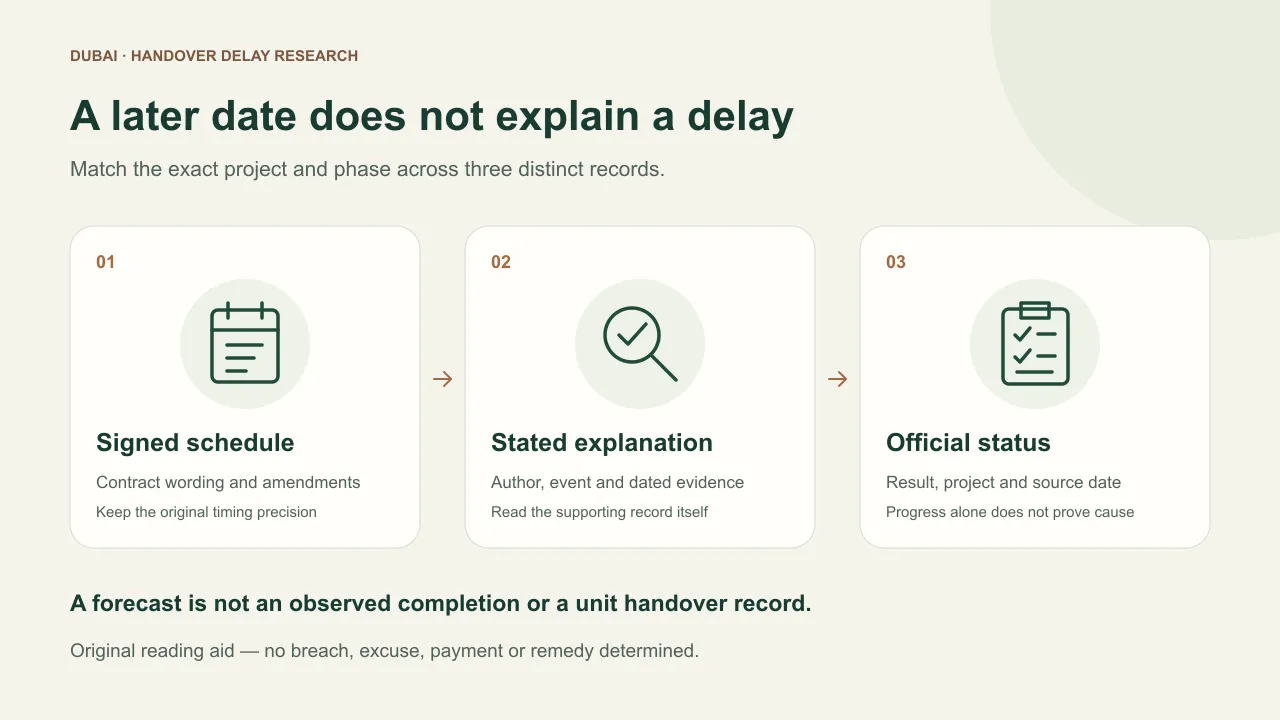
If your Dubai handover date changes, put the new notice beside your signed sale and purchase agreement (SPA). Check which date moved, look up the project with Dubai Land Department (DLD), and ask the developer for the reason and revised timetable in writing. Before changing your move, check two deadlines the developer cannot extend for you: your mortgage offer expiry and the last day to give notice on your current home.

Sources checked 20 November 2026 · the iOffPlanDubai team.
Which Dubai handover date actually moved?
Look for the verb beside each date. “We expect to complete the building in June” tells you less than “Please attend the handover of unit 502 on 18 June.” The first gives you a forecast for the building. The second gives you an appointment for a particular home. A notice might instead move only your inspection. Save the original email and attachment, including the day you received them.
Use this checklist today. If you cannot fill a box from a document, write “unknown” and put the question to the person who can answer it.
| Check | What to write down | Who can confirm it |
|---|---|---|
| Signed promise | Clause, exact wording and date or quarter in the SPA and any signed amendment | Developer for its interpretation, your adviser if disputed |
| New notice | Issue date, unit or phase, event that moved and new date or range | Developer handover team |
| Project record | Project number, completion percentage and day you looked it up | DLD project status service |
| Finance | Offer expiry, last day for release and documents still needed | Your lender |
| Current home | Lease end, notice deadline and any written extension | Your landlord or managing agent |
| Move | Inspection, keys, lift booking and last day to change movers | Handover team, building manager and mover respectively |
Read the contract alongside the notice
Open the signed version of the SPA, including its payment schedule. Find the words it uses for completion and handover. Copy the whole sentence that gives the date, including words such as “anticipated.” If it gives a quarter, keep the quarter on your sheet. Turning that into a day of your choosing could make a delay look more certain than the wording supports.
Then find any clause allowing an extension. Mark who may give notice, how it must be delivered, what event permits more time and any limit stated in the clause. Check later signed amendments in date order. If you cannot find a grace period, ask the developer to identify the clause it relies on. Leave the end date open until you have an answer you can check.
Read the next instalment separately. What makes it due under the signed schedule: a fixed date, a construction milestone or the handover notice itself? Ask for the relevant document and due date for your unit. Keep any existing payment deadline visible while you query it. If the notice actually says your unit is ready for collection, use the handover notice checklist before the appointment.
Check the project with DLD
Open Project Status Enquiry and search using the project number on your purchase documents. The service also accepts the project name or land number. Match the result to your building or phase, particularly if several towers share a sales name. Save the result with the day you searched. If the record gives a separate inspection or update date, keep that alongside the percentage. DLD Project Status Enquiry, checked 20 November 2026
DLD describes construction progress for the project. You still need the developer to confirm access to your particular flat. If DLD and the developer give different percentages, check the phase and the dates before drawing a conclusion. If you find no matching result, ask for the registered project name and number. A blank search tells you nothing about how much work has been done.
Ask for the reason in writing
Send a short note from your registered contact address through the channel set out in your SPA. Include the unit, project, old notice and new notice. A reply that says only “on track” leaves you with the same booking problem. Ask which work or approval remains and when the team will update you if it cannot yet give a firm day.
Message you can copy
I own [unit] in [project and phase]. My signed SPA describes [event] as due [wording and date]. Your notice dated [date] gives [new event and date]. Please confirm what changed, why, and the clause you rely on for any extension. What remains before I can inspect the unit and collect the keys? Please confirm my next payment trigger and due date. If an appointment is still unknown, when will you send the next written update?
Keep the sent message and reference number. If the team calls, email back a short account of what you understood and ask them to confirm it. If you receive a form headed “amendment,” read what it changes about dates, payments or claims before signing. When the date has passed and you are considering a remedy, take the signed papers and replies to a Dubai property lawyer. Article 20 identifies grounds on which a buyer can ask a court for termination. The delayed handover action plan covers how to prepare that file. Executive Council Resolution No. 6 of 2010, Article 20, checked 20 November 2026
Will the mortgage offer last long enough?
Find the most recent letter your bank issued and read its heading. If you have an approval in principle, ask when you must apply for the full loan. HSBC UAE, for example, gives its approval in principle 60 days. That is one bank's preliminary approval period. For a final offer, take the expiry and release conditions directly from your letter and confirm them with the lender. HSBC UAE mortgage application guide, checked 20 November 2026
Send the lender the revised timetable. Ask which date is the deadline to accept, which is the deadline for funds to reach the developer, and whether the valuation or income documents will need refreshing. Ask what an extension involves, including any cost, and when you would need to request it. Put the bank's reply beside the developer's payment deadline. The handover mortgage guide walks through a funding gap if the two dates no longer fit.
How do you spot the first deadline at risk?
Suppose your final mortgage letter says funds must be drawn by 15 July. The developer has moved the key appointment from 10 July to 5 August. Your payment schedule calls for the balance on notice of readiness, and the new email says nothing about that notice. Put “unknown” against the revised payment date. Using 5 August for both the payment and the keys would hide a question only the developer can answer.
Send the bank the two appointment dates and highlight the 15 July condition in its own letter. Ask whether it can release against the existing documents, what it still needs, and the last day to request an extension. At the same time, ask the developer when it expects to issue the payment notice. If the bank gives you a decision deadline of 1 July, put that day in your calendar now. You have a useful next action even while the exact release date is unknown. These dates are a worked example. Use the conditions in your own offer.
Can you still move out on time?
Read your current tenancy agreement before giving notice. Write down the last date to tell the landlord your plans. If you have already given notice, ask the landlord in writing whether a short extension is available, on what terms and by when you must decide. An unanswered request leaves the original move-out plan in place for budgeting purposes.
For example, suppose your lease ends on 30 June and the developer now expects completion “in July.” Even 1 July is only the start of that range. You still need a key appointment and permission to bring furniture in. Ask the building manager what evidence it needs to book the service lift. Check the mover's change deadline and keep the written quote for any storage or extra rent. The move-in permit guide explains what to ask your new building.
What else do buyers ask?
What if the developer brings handover forward?
Check whether the letter offers an earlier appointment or also demands payment earlier. Ask the developer to identify the clause behind any new deadline. Send the letter to your bank the same day and get its earliest release date before you agree to a collection slot.
What if I have only a phone call or a message from my agent?
Record the date, the caller and the exact event they described. Ask the developer's handover team to confirm it through the contact route in your agreement. If your lease decision falls due first, tell your landlord what you can confirm and ask when any extension offer expires.
Can I claim the extra rent or moving costs?
Keep the tenancy extension, invoices, receipts and notices so an adviser can trace what the change actually cost. Whether you can recover any amount depends on your agreement, the facts and the applicable law. Treat those costs as yours to budget for while a claim remains unresolved.
Sources
- Dubai Land Department · Project Status Enquiry — dubailand.gov.ae · checked
Project-level completion percentage and details. The website and app accept a project name, project number or land number.
- HSBC UAE · How to apply for a mortgage — hsbc.ae · checked
The bank gives its own approval in principle a 60-day validity period. Final lending requires a separate application.
- Dubai Legislation Portal · Executive Council Resolution No. 6 of 2010 — dlp.dubai.gov.ae · checked
Article 20 sets out grounds on which a purchaser may ask the competent court to terminate the contract.
Next stepDelayed handover of property in Dubai (Action Plan) →
More in Handover
Start here: Delayed handover of property in Dubai (Action Plan)
- Best Snagging Companies in Dubai: 3-Firm Checklist
- Property handover delay in Dubai: 5 checks for buyers
- RERA Dubai Cancelled Projects List: Check Status & Refunds
- Dubai handover snagging checklist, room by room
- Got Your Dubai Handover Notice? 7 Checks Before the Keys
- Defect liability period Dubai: 1-year and 10-year rules