District cooling companies in UAE: Dubai providers and bills
Compare Emicool, Empower and Tabreed without rankings. Identify your building's cooling provider, separate RT from RTh and query a bill through RSB.

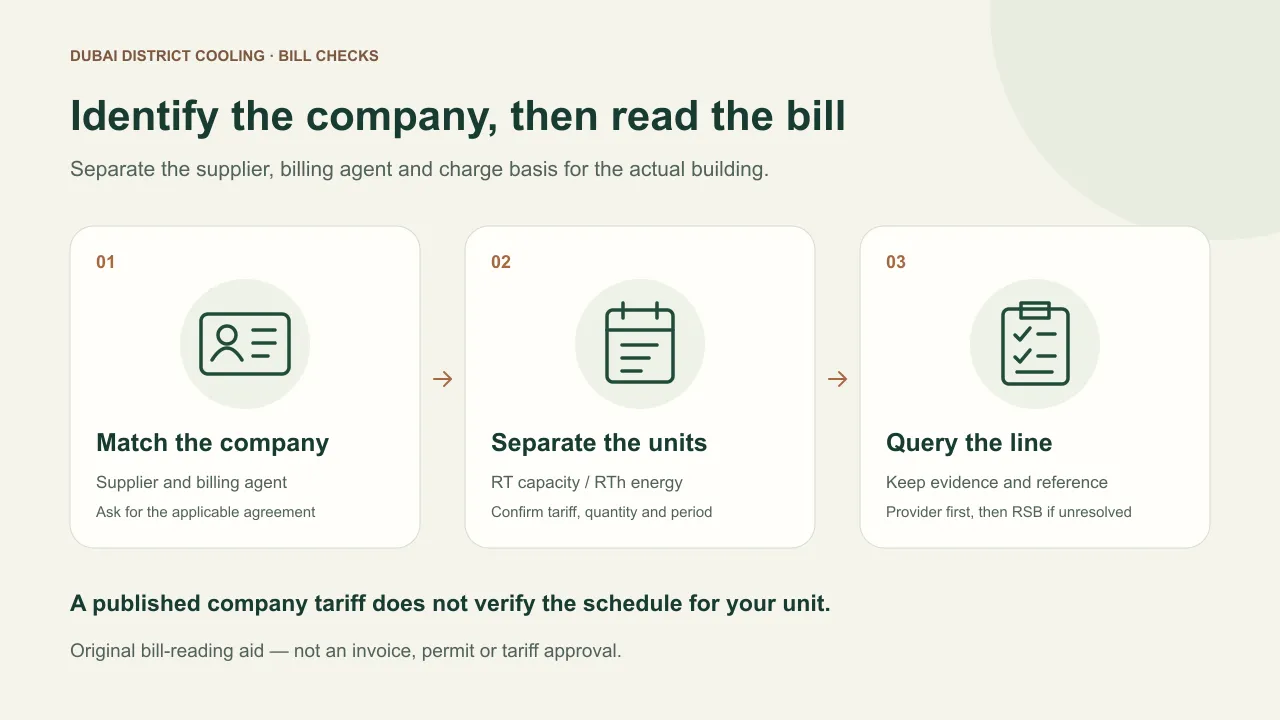
Emicool, Empower and Tabreed are three district cooling companies to know when researching a Dubai home. They appear in RSB's official permitted-sector report for 2024; the alphabetical list below is unranked and carries no paid placements. For your bill, first identify the company serving the exact building and any separate billing agent, then check the applicable tariff and contract (RSB report, The Permitted Sector, checked 9 November 2026).
Which district cooling companies should you check?
These three companies appear in RSB’s 2024 report and publish customer information. Check current permits and building coverage separately. RSB's current cooling page is the starting point for a fresh permit check (checked 9 November 2026).
| Company | Official customer source | Useful distinction |
|---|---|---|
| Emicool | Customer information and procedures | Read the unit agreement, payment arrangements and final-bill route; ask Emicool for the tariff that applies to your building |
| Empower | Published charge explanations | Demand, metered consumption and other charges are separate lines; confirm the applicable schedule for the unit |
| Tabreed | Customer Service Charter | The charter distinguishes Tabreed's bulk-customer role from subsidiary Tasleem's individual-customer billing role |
Company sources checked 9 November 2026. A brand name is not a match to every subsidiary or property. Do not infer your building's supplier from its neighbourhood alone. For a home near the Dubai Water Canal, request the building's actual bill and service details alongside the rent proposal.
Can you choose a different cooling company?
First ask building management which network, supplier and billing agent serve the address, and request the relevant account-registration instructions. RSB distinguishes district cooling, single-building cooling and billing-service permits on its framework page (checked 9 November 2026). The name on a collection notice may therefore identify a billing role rather than the plant operator.
Do not assume this company list is a menu of interchangeable suppliers for your apartment. Whether an alternative is available at that address remains a building-specific question. Use the owners committee and management guide to distinguish management responsibilities before asking who authorises or explains the service arrangement.
RT versus RTh: what are you paying for?
RSB RD10, issue 1.4, published 6 February 2026, defines capacity and usage separately. Schedule 2 identifies buildings and Schedule 3 approved tariffs. Earlier approved tariffs remain until amended, reapproved or superseded under the regulation (checked 9 November 2026).
| Bill component | Unit or basis | What to request |
|---|---|---|
| Capacity / demand | RT capacity × an annual AED/RT tariff, apportioned to the bill period | Unit allocation, tariff and period |
| Consumption | Metered RTh energy × AED/RTh tariff | Opening/closing readings, usage and rate |
| Other charges | Applicable approved fee basis | Item name, schedule and reason |
RT is a capacity measure; RTh measures cooling energy. Neither is simply the number of hours you switched the thermostat on. Ask for the approved schedule applying to the building and your unit, rather than multiplying a tariff found for another property.
One provider's published capacity example
Empower's charge page states AED 750 per RT per year, billed monthly in advance by days (checked 9 November 2026). Illustrative calculation: at an assumed allocation of 4 RT, 4 × 750 = AED 3,000 per year, or AED 250 as a simple monthly budget average, before consumption and other applicable items. Four RT is an invented example; AED 250 is not an actual monthly invoice or a cross-provider tariff.
The page’s consumption wording mixes “AED” with “fils.” Ask for a tariff sheet stating the currency and AED per RTh before calculating your bill.
Empower also says demand and meter-maintenance fees continue during voluntary disconnection. Turning cooling off does not by itself establish a zero bill. The cited statement is provider-specific; confirm the signed terms for the actual account.
What does “chiller free” mean for a rental comparison?
Ask the landlord to specify in writing who pays each component and what, if anything, is included in rent. The phrase alone is insufficient to fill a cost worksheet. Use our rental-price comparison guide to compare annual running cost separately from move-in deposits.
Before signing, request:
- The supplier and billing company's exact legal names, plus the account route.
- A dated tariff sheet, unit capacity allocation and a sample bill for the same unit with personal information removed.
- Written responsibility for demand, consumption, billing fees, deposits and move-out settlement.
- A clear repair contact for cooling failure inside the home and the boundary with the external supply service.
A building's approved service-charge rate and a separate cooling account should be reconciled by checking the actual items, not assuming that one includes the other.
How to query a cooling bill or service problem
RSB consumer-protection guidance says to contact the supplier or billing agent first. If no response arrives or the issue remains unresolved, a consumer may use the regulator's complaint route; evidence and a genuine prior attempt to resolve the issue are required (checked 9 November 2026).
Our practical record template:
- Save the bill, period, meter readings, tariff version and account reference privately.
- Identify the specific question: incorrect period, unexplained allocation, rate mismatch, missing credit or service interruption.
- Contact the verified company channel shown by the provider; retain the reference and written response.
- If unresolved, open the regulator's official page above and follow its current complaint instructions with that evidence.
Copyable query: “Please explain this line's quantity, unit, rate and billing period, identify the approved tariff schedule, and reconcile it with the attached bill/reading.” Ask for a response date and keep the reference. For a separate landlord–tenant disagreement about the lease, use the RDC guide to identify the appropriate service.
Frequently asked questions
Which district cooling company is best in Dubai?
The three providers are listed alphabetically. Ask which company serves your building, then compare its tariff and terms for your unit.
Is the billing agent always the cooling supplier?
No. RSB recognises a separate billing-services permit. Tabreed's cited charter illustrates the distinction through Tasleem's end-user role. Match the legal entity on your own agreement and bill.
Is capacity the same as consumption?
No. Compare the allocated RT capacity and metered RTh energy separately. A lower consumption figure does not itself eliminate a capacity component under the applicable arrangement.
Where do I complain if the company does not resolve the issue?
Follow the official RSB consumer-protection route after contacting the supplier or billing agent. Retain the bill, question, contact reference and response; the regulator says unsupported complaints may not be processed.
Sources
- RSB Dubai — Regulating Efficient and Sustainable Cooling — https://www.rsbdubai.gov.ae/en/regulating-efficient-cooling/ · checked
Opened regulator framework and three permit categories. Current permit-holder cards and individual permit numbers were not exposed in the readable response; do not present the historical brand list as a live permit validation.
- RSB Dubai — Annual Report 2024, The Permitted Sector — https://rsbdubai.gov.ae/wp-content/uploads/2025/10/Annual-Report-on-2024-EN-V5-compressed.pdf · checked
Opened official report lists Emicool, Empower and Tabreed among the nine brands behind permitted district-cooling providers in the 2024 reporting period. This is historical regulator evidence, not a current expiry or building-schedule check.
- RSB Dubai — RD10 tariffs, charges and fees, issue 1.4 — https://rsbdubai.gov.ae/media/baufmpnp/rd10-tariffs-v14.pdf · checked
Issue 1.4 publication 6 February 2026. Defines capacity in RT and consumption in RTh, Schedule 2 buildings and Schedule 3 approved charges. Older approved tariffs remain until changed under the regulation. No unit tariff or approval validated here.
- Empower — Charges Explanation — https://www.empower.ae/customer-care/charges-explanation/ · checked
Opened provider page states AED 750 per RT per annum demand charge and continued demand/meter fees during voluntary disconnection. Consumption sentence says AED 0.568 fils per RT per hour; ambiguous currency wording is not silently converted into a verified tariff.
- Emicool — Customers — https://www.emicool.com/customers/ · checked
Opened provider customer page describes agreements, billing and cancellation/final-bill procedures. No readable complete tariff schedule established for a selected property; no price or deposit extrapolated.
- Tabreed — Customer Service Charter — https://tabreed.ae/sites/default/files/2025-12/Customer_Service_Charter_English.pdf · checked
Opened provider charter distinguishes Tabreed/bulk-offtaker role and Tasleem/end-user billing role, and names permitted entities at publication. URL folder is not treated as the document's verified publication date or current permit expiry.
- RSB Dubai — Consumer protection — https://rsbdubai.gov.ae/en/consumer-protection · checked
Opened official escalation guidance requires first contacting supplier/billing agent and retaining documented evidence. No complaint, response time or outcome verified.
More in Living in Dubai
Start here: Best places to work remotely in Dubai: 4 areas compared
- Best area to live in Dubai for singles: 11 options
- Pet registration Dubai: cats, dogs and clinic checks (2026)
- Makani real estate Dubai: find the correct entrance
- Renting without Ejari in Dubai: what to do next
- Dubai Water Canal living: pros, cons and costs
- Maid visa cost Dubai — official routes and fees in 2026
- HIVE JVC Dubai: coliving, rent and lease checks (2026)
- Taskeen Dubai: property residence, documents and fees (2026)
- Dubai cycling routes: open tracks and future plans
- Dubai vs New York: compare housing, work and costs
- Nanny, maid and driver rooms in Dubai: home checks
- Al Mizhar Dubai: living, schools and transport (2026)
- Skate parks Dubai: XPark and Dubai Hills Park
- Best parks in Dubai: six options and how to plan a visit
- Best places to work remotely in Dubai: 4 areas compared