District cooling bill Dubai: charges and query steps
District cooling bill Dubai: read RT and RTh, check Empower and Emicool charges, spot estimated readings and prepare a bill query for RSB.
To check a district cooling bill, Dubai residents need three things: the unit's capacity allocation, the metered consumption and the building's tariff. Query a mismatch with the supplier or billing agent first; if they don't answer or don't resolve it, you can complain to RSB Dubai, the regulator.

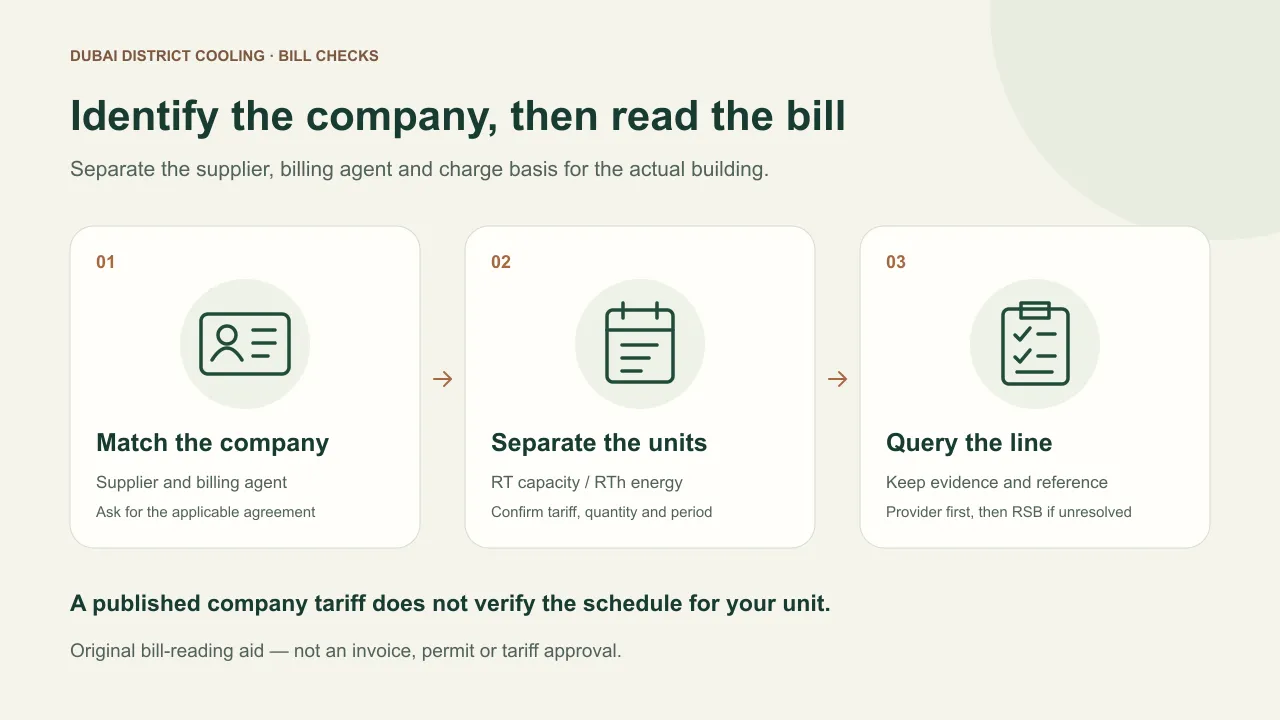
Start with the bill period and meter number. A higher balance due can include an older unpaid amount, while a charge for cooling capacity can remain even when you've used little cooling. Ask which line changed before disputing the whole total.
District cooling bill Dubai: which lines should you check?
Use this worksheet beside the invoice. Keep the rate's unit written out: an annual capacity rate and an energy rate can't be compared as if they were the same charge.
| Bill line | What to compare | What to request if unclear |
|---|---|---|
| Capacity or demand | Allocated RT × annual AED/RT rate, apportioned to the period | Unit allocation and billing dates |
| Consumption | Metered RTh × AED/RTh rate | Readings, dates and calculation |
| Fuel surcharge | Quantity, rate and whether already included | Applicable tariff breakdown |
| Metering or billing | Period and approved fee | Name and basis of each fixed item |
| VAT | Taxable lines and tax amount | Itemised tax calculation |
| Previous balance | Earlier invoices, credits and payments | Account statement |
| Amount due | Current charges plus reconciled older balance | Due date and payment reference |
RSB's RD06 metering and billing rules, clause 8, specify bill details including meter serial number, contracted capacity, dates, readings and tariffs. They distinguish current charges from the previous balance and total due. Checked 17 November 2026; money in AED, capacity in RT and energy in RTh.
If you don't know who bills the home, use the Dubai cooling-company guide first. This page is for checking an invoice after you've identified the account.
If the projected cooling bill relies on a green rating, check the Dubai Municipality Al Sa’fat levels and evidence before counting the saving.
What do RT, TR and RTh mean?
RT and TR refer to refrigeration tons, a measure of cooling capacity. RTh or TRh measures cooling energy. The annual capacity rate is normally stated in AED per RT per year; the consumption rate is in AED per RTh. These definitions come from RSB RD10, checked 17 November 2026.
Copy the metered quantity and its unit from the invoice. Hours with the thermostat on aren't a metered energy quantity. If a reading appears in kWh while the charge uses RTh, ask the billing company to show its conversion.
Hypothetical statement check: assume AED 600 in new charges, AED 100 brought forward, an AED 80 credit and an AED 100 payment not already deducted. Then AED 600 + AED 100 − AED 80 − AED 100 = AED 520 due. These are invented worksheet inputs, not a typical Dubai bill or a provider quote.
Check when each payment reached the account before using this calculation. If the opening balance already includes a credit or payment, don't deduct it twice. Ask for a statement covering both the previous invoice and the current one.
What does Empower publish, and what needs confirming?
Empower's Charges Explanation, checked 17 November 2026, lists:
| Item | Published figure and condition |
|---|---|
| Demand | AED 750 per RT per year; monthly in advance, calculated by days |
| Meter maintenance | AED 50 per three months or AED 30 per month, depending on location |
| Meter test | AED 160 if no fault is found; no test charge if faulty |
| Voluntary disconnection | AED 150 per request; demand and meter charges continue |
| Non-payment disconnection | AED 500; settlement and account-holder request required for reconnection |
| VAT | 5% on listed charges/services |
Hypothetical demand calculation: assume an allocation of 4 RT and a 30-day period in a 365-day year. Then 4 × AED 750 ÷ 365 × 30 = AED 246.58 before VAT. The allocation and period are assumptions; this isn't a complete invoice.
The consumption sentence on Empower's page mixes “AED” and “fils”. Ask for a current tariff explicitly stating AED per RTh, including how fuel is treated. A complete current consumption price isn't confirmed here. Don't quietly turn ambiguous currency wording into a budget figure.
Before requesting a meter test, ask what it covers and how the result will be delivered. Keep the test report with your query rather than assuming that a test request alone changes the invoice.
How do Emicool charges and due dates work?
Emicool's FAQ, checked 17 November 2026, says the capacity rate comes from the contract and is split into monthly payments regardless of connection or consumption. It publishes a refundable deposit equivalent to eight months of contracted capacity charges and a one-time AED 200 activation fee.
The FAQ says invoices are generated on the first day of the month, due within 15 days of the invoice date, and identifies an AED 100 late-payment fee. Use the due date on your own bill and query any difference promptly. A complete tariff for your unit isn't confirmed here.
Download the invoice from the customer portal and request the signed agreement's tariff attachment. Keep deposits separate from monthly costs when budgeting. If someone quotes a single “Emicool rate”, ask which building, effective date and charging unit it applies to before using it.
For account setup, check the tenancy details against your Ejari documents (see the Ejari and tenancy-contract checklist). Keep the cooling account reference separate from your electricity and water account.
Which tariff rules should you ask the billing company about?
RSB's RD10 issue 1.4, published 6 February 2026 and checked 17 November 2026, links buildings to approved tariffs through permit Schedules 2 and 3. Earlier approved tariffs remain until changed under its provisions. A cap isn't automatically your payable rate.
Selected points to check against the published rule:
| Question | RD10 provision to raise |
|---|---|
| Which capacity belongs to my unit? | Section 6 requires its allocated share of building contracted capacity |
| Why is low delta-T on my unit bill? | Section 6 excludes inefficient-building penalties from unit bills |
| Is this a single-building system? | Section 7 sets an AED 0.80/RTh consumption cap and excludes capacity charges to its units |
| What is the energy cap for the capacity-plus-consumption structure? | AED 0.643/RTh, inclusive of fuel surcharge, subject to the regulation's approval framework |
| What fixed billing fee is approved? | AED 30/month cap, with specified new/renewed-service and building-addition conditions |
Ask the company to identify the system category, applicable approval and effective date. Send that answer to RSB if you still can't reconcile the charge. Don't apply one row to a different system or subtract a disputed amount on the strength of the table alone.
Why do you still pay when the AC is off?
Check whether the remaining amount is demand, metering or an earlier balance. Empower says demand and meter-maintenance fees continue during voluntary disconnection; Emicool says its capacity payments continue regardless of use or connection. Sources: the provider pages above, checked 17 November 2026.
Ask for the fixed recurring amount before accepting an off-plan home or signing a lease. That is more useful for your holding budget than a low-use month's total. Request a redacted statement for the exact unit if one is available; a neighbouring apartment's allocation isn't your confirmed allocation.
For “chiller free”, ask the landlord to state which lines are included and who keeps the supplier account. Put capacity, consumption, metering and final settlement into the question. If the lease wording and supplier agreement seem inconsistent, ask each party to explain its responsibility in writing.
What if the reading is estimated or the bill suddenly jumps?
RD06 requires estimated values to be identified with “E” and an explanatory key. For a faulty sub-meter, clause 7(d) permits estimates for at most two billing cycles, using the prior-year comparable month or, without that history, the previous month. If repair or replacement isn't arranged within those cycles, it bars consumption charges until reliable metering is restored. RSB RD06, checked 17 November 2026.
Ask when the fault was first noticed, which periods were estimated and when the meter was repaired. Save the earlier invoices. Ask RSB how the provision applies to your case if the company can't explain a continuing estimate.
For an actual reading, compare the meter identifier and reading dates before focusing on the amount. Ask about a meter replacement, a longer billing period or a rate change. Request the old and new records if the meter changed; subtracting readings across different meters can produce a meaningless result.
For a warm apartment, contact facilities management as well as opening the billing query. Empower's FAQ directs cooling-service faults there; checked 17 November 2026. Record the affected room and time, then ask for the technician's findings. Don't diagnose faulty equipment from the invoice alone.
How do you query a bill without losing the evidence?
Send one clear question about each disputed line. Here's a template. Replace the brackets with your own details and send it privately:
My invoice [reference] covers [dates]. Please explain the [named charge]. The bill shows [quantity and unit] at [rate], but [specific mismatch]. Please provide the applicable tariff, reading record and calculation, and confirm the amount and due date while you review it. My earlier contact reference is [reference].
Attach the invoice and relevant previous statement. Include a dated meter photograph only if you can take one with permission; ask management for access rather than interfering with the meter. Keep identity and account papers out of community chat groups.
For Empower, its FAQ lists +971 4 5592888 and [email protected]. For Emicool, use the customer portal; its FAQ also lists 600534440 and [email protected]. Provider contacts checked 17 November 2026. For another billing agent, use the contact on its confirmed official page or account portal.
Ask what happens to payment obligations during review. Don't assume that opening a complaint pauses the due date or prevents disconnection. Keep the company's answer and any agreed payment arrangement with the query reference.
When should you escalate a cooling complaint to RSB?
RSB's consumer-protection guidance says to contact the supplier or billing agent first. If there's no response or the issue remains unresolved, you may submit a formal complaint with evidence. It warns that cases without a genuine prior attempt at resolution will be rejected. Checked 17 November 2026.
Prepare the invoice, agreement or tariff, your written question and the company's replies in date order. The RSB complaint form asks for the account, building, permit holder, complaint details, attachments and dated contact history. Checked 17 November 2026. A universal resolution deadline isn't confirmed here.
Say what you want corrected: “Please check the reading for this period and explain the revised amount.” For a disagreement with your landlord about lease wording, keep the contract and supplier's reply with the Rental Disputes Center guidance and ask which route fits.
What should you do before moving out or selling?
Empower's final-bill procedure uses My Services → Final Settlement, with separate tenant and owner instructions. It lists a normal final-bill time of two working days after receiving the request. Tenant papers include Ejari/tenancy, identity and a bank IBAN header; specified cases also need an owner NOC. Checked 17 November 2026.
Emicool's customer page describes a final bill within three working days after its submission and settlement steps, with the final amount deducted from the deposit. For an ownership transfer, agree the cutoff with the master developer and notify Emicool before applying. Checked 17 November 2026. Final-bill issuance and completion of the deposit refund are different dates.
RD06 clause 8(c) requires the held deposit to be returned within five working days of concluding service. Ask the provider to confirm when it considers service concluded and give you a final reconciliation. Escalate an unexplained delay with the closure reference. Source: RSB RD06 above, checked 17 November 2026.
Use the moving-out checklist to track this alongside other closures. Record the agreed cutoff, final reading, final invoice, deposit deductions and refund confirmation separately.
If you are opening the account for a newly completed home, put the cooling deposit beside your other move-in payments in the Dubai handover costs timeline.
Frequently asked questions
Is a common-area cooling charge part of my unit's consumption?
Ask management to explain the spaces and periods covered. RD06 clause 9 restricts billing agents from redirecting common-area charges to unit occupants and addresses consumption redistribution through service charges. Compare the explanation with your building service-charge statement before alleging duplication. RSB RD06 checked 17 November 2026.
Who regulates the billing agent?
RSB's cooling framework distinguishes supplier, single-building and billing-services permits. Ask management for the legal entity handling your account and its permit details. Framework checked 17 November 2026; no individual permit was verified for this article.
What is a normal monthly cooling bill?
There's no Dubai-wide figure we could verify. You need the unit's allocation, approved tariff, actual consumption and lease inclusions. Compare the same unit over comparable periods, with one-off costs and previous balances separated.
Can reducing cooling use remove every charge?
Check the fixed lines in your agreement before forecasting savings. Empower's FAQ suggests thermostat settings and reducing losses through windows and doors to lower consumption. That doesn't promise a reduction in fixed fees. Ask for a usage trend and compare the metered energy after making changes.
Sources
- RSB Dubai — Regulating Efficient and Sustainable Cooling — rsbdubai.gov.ae · checked
Regulator framework distinguishes district cooling, single-building cooling and billing-services permits. No individual company's current building authorisation verified.
- RSB Dubai — RD10 tariffs, charges and fees, issue 1.4 — rsbdubai.gov.ae · checked
Published 6 February 2026. Capacity AED per RT per year; consumption AED per RTh. Sections 1, 3, 6 and 7 address approved building schedules, preserved earlier approvals, unit allocations, low-delta-T exclusion and conditional caps. Caps are not account tariffs or an individual refund decision.
- RSB Dubai — RD06 metering and billing, issue 1.1 — rsbdubai.gov.ae · checked
Version dated 11 September 2024. Clauses 7(d), 8 and 9 cover faulty sub-meter estimates for at most two billing cycles, bill fields and E marking, deposit-return requirement of five working days after concluding service, and common-area billing. No meter test or individual invoice adjudication performed.
- Empower — Charges Explanation — empower.ae · checked
Demand AED 750 per RT per year, day-based monthly advance billing; meter AED 50 per three months or AED 30 per month by location; listed service fees and 5 percent VAT. Consumption wording mixes AED and fils so no current consumption rate is inferred. Links the existing official monthly-bill video facade; no tariff inferred from video.
- Empower — FAQs — empower.ae · checked
Billing helpdesk +971 4 5592888 and [email protected]; cooling-service faults to building facilities management. Provider guidance, not a response-time guarantee.
- Emicool — Frequently Asked Questions — emicool.com · checked
Contract-specific capacity rate, monthly invoices generated on first day and due within 15 days, AED 100 late fee, deposit equivalent to eight months of contracted capacity charges and AED 200 activation fee. Customer portal and 600534440 for billing queries. No complete property tariff or universal consumption price confirmed.
- Emicool — Customers — emicool.com · checked
Tenant cancellation final bill within three working days after the required submission and settlement steps; final balance deducted from deposit. Ownership cutoff agreed with master developer and notified to Emicool. Express option AED 500 plus VAT with separate conditions; no deposit refund completion date inferred.
- Empower — E-Final Bill Procedure — empower.ae · checked
Separate tenant, owner and clearance paths; My Services and Final Settlement; normal final bill within two working days after receipt of request. Tenant documents include Ejari or tenancy, identity and bank IBAN header, plus owner NOC in stated cases. No individual closure or refund verified.
- RSB Dubai — Consumer protection — rsbdubai.gov.ae · checked
Contact supplier or billing agent first; unresolved or unanswered cases may be escalated with documented evidence. No universal complaint-resolution deadline confirmed.
- RSB Dubai — District Cooling and Billing Agent Complaint Form — rsbdubai.gov.ae · checked
Opened form requests account, building, permit holder, complaint details, attachments and dated supplier interactions. Read only; no complaint submitted.
Next stepDubai Properties Service Charges: DLD Index & Calculator →
More in Ownership costs
Start here: Dubai Properties Service Charges: DLD Index & Calculator
- When Do Dubai Landlords Pay Tax on Rental Income?
- Dubai property payment plans compared by cash due date
- Is VAT Charged on Property in Dubai? A Buyer’s Guide
- Dubai Municipality Housing Fee: Check Your DEWA Bill
- Central garden in Dubai homes: access and cost checks
- Home Renovation Permit Dubai: NOCs, Fees and Approvals